Microsoft shipped PowerToys Preview v0.102.2862.0 to its Insider channel today, delivering a headless command-line interface for Advanced Paste. The new CLI drives the same action engine as the graphical app, so it inherits AI, OCR, and media transcoding without ever opening a window. Command Palette also gains a proper full-screen way to position its compact mode, while New+, Settings, and the build pipeline pick up a batch of stability fixes. Since it's a pre-release, scripters should test the new command line but stability-focused users should stay on the current stable build.
Microsoft's PowerToys Preview Gives Advanced Paste a Headless Command Line
Microsoft delivered PowerToys Preview v0.102.2862.0 to its Insider channel today, and the headline change quietly does something the utility suite has wanted for a long time: a real command-line interface for Advanced Paste. You can now drive clipboard transformations from a terminal instead of a window. It's a modest release by the numbers, but the biggest thread in it matters far more to scripters than to casual users.
The newest PowerToys preview adds a genuine CLI for Advanced Paste, repositions Command Palette's compact mode, and quietly keeps the whole 0.102 milestone rolling.
Maintainer Boliang Zhang, known as LegendaryBlair, published it today. It picks up from preview v0.102.2851.0, which arrived two days earlier. Like every preview channel drop, this isn't the finished article. It's an opt-in build aimed at testers hunting for bugs before the work reaches the stable channel.
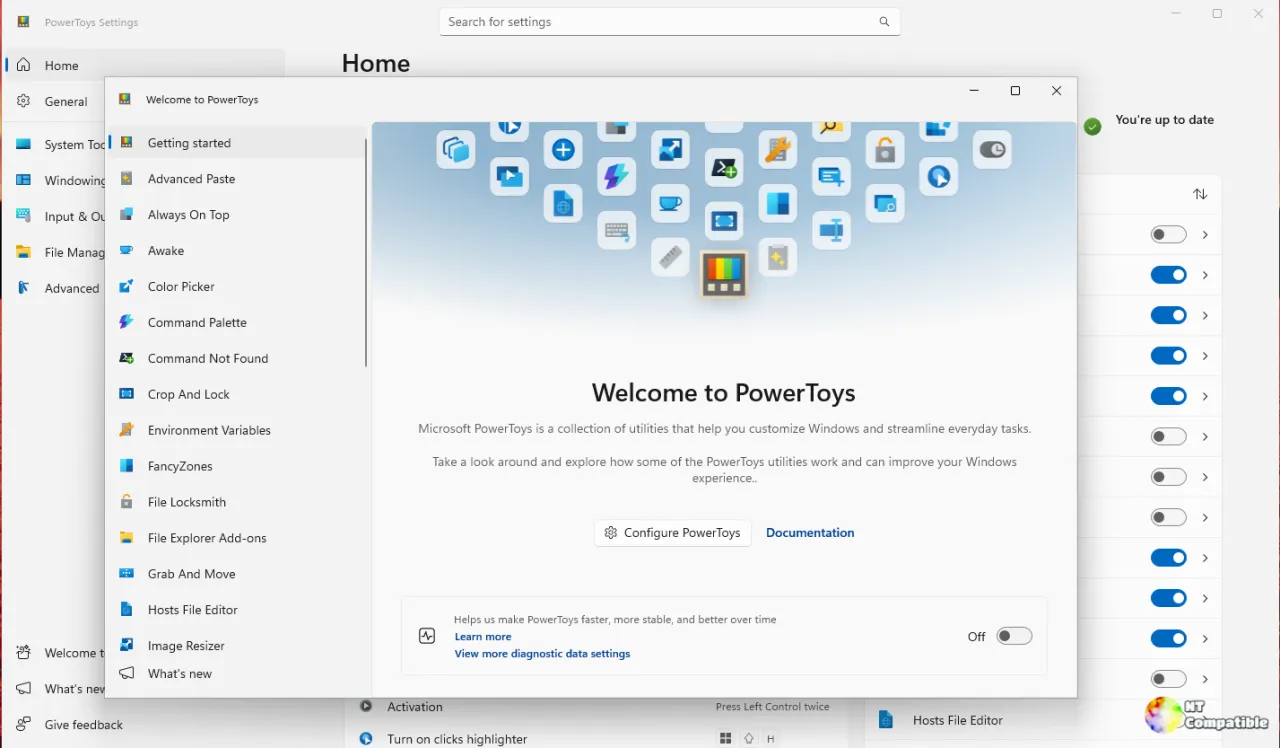
Advanced Paste finally talks to your shell
Advanced Paste has always been a mouse-and-window affair. You hit a shortcut, a menu pops up, and you pick whether the clipboard should become plain text, Markdown, JSON, or something AI-assisted. That was the whole experience. The new command line, delivered through PR #50834 by Muyuan Li (MuyuanMS) and merged on October 13, changes that. It also closes issue #49902, the long-running feature request that kept nagging the project.
Here's the part worth paying attention to. The new CLI doesn't fake it. It calls Advanced Paste's shared action engine directly, so it runs through the exact same transformation pipeline the GUI uses. No window opens. It doesn't talk to the PowerToys Runner process, and it doesn't simulate keystrokes the way some older automation hacks do.
The result is a self-contained executable you reach through a PATH-visible shim called PowerToys.AdvancedPaste.CLI.exe. Point it at a command and it inherits the full feature set: AI actions tied to whatever provider you configured, OCR, policy checks, the Credential Vault, media transcoding, the works. Nothing gets watered down for the command-line version.
The surface itself is small. Two listing commands and one transform command cover most of it.
PowerToys.AdvancedPaste.CLI.exe actions list [--json]
PowerToys.AdvancedPaste.CLI.exe providers list [--json]
PowerToys.AdvancedPaste.CLI.exe transform --action <name> --input <path>
Clipboard is the default input and output when you don't specify them, which keeps one-liners terse. Built-in actions range from plain-text and markdown to fix-spelling-and-grammar, image-to-text, and file producers like paste-as-png-file. There's also transcode-to-mp3 and transcode-to-mp4 for anyone who wants to strip audio out of a recording on the fly.
Want to see it actually run? From the PR's own PowerShell example, you can pipe text into stdin and pull the result straight back out.
'Hello from stdin' | & $cli transform --action plain-text --stdin
Get-Clipboard  # => Hello from stdin
It's honest about failure too. Exit codes follow convention: 0 for success, 1 when something actually breaks, 2 for your own parsing mistakes. Unknown action IDs don't silently fall back. They return a machine-readable unsupported_action error instead, which is exactly what you want when a script is doing real work. Text input is capped at 16,777,216 characters, and Microsoft notes that raw input, prompts, and output are never logged. Telemetry records only a bounded command name like transform or actions list.
There's an architecture choice worth a look. The team pulled Advanced Paste's non-UI helpers into a shared library called AdvancedPaste.Engine so the CLI and the WinUI app can't drift apart over time. A single executor and shared policy logic keep both paths making the same decisions. The whole thing is guarded by 79 new tests on top of 56 existing unit tests. A follow-up PR later migrated the broader PowerToys command-line surface to System.CommandLine 2.0 as well.
For most people this feature won't even exist. But for sysadmins, developers, and anyone wiring clipboard work into a CI pipeline, Advanced Paste just became a real, scriptable endpoint instead of a paste menu.
Command Palette gets a real grip on its window
While Advanced Paste was getting its command line, Command Palette picked up a far more natural way to place its compact mode window. Compact mode, introduced in v0.101, is PowerToys' way of keeping its fast launcher unobtrusive. It's often described, in the same breath as macOS Spotlight, as what Windows Search should have been all along.
Previously you set compact mode's vertical position with a horizontal slider. That's a fiddly, indirect way to position something on your screen. PR #51011, by Jiří Polášek and reviewed by Michael Jolley, replaces it with a full-screen picker. You drag the actual ghost window to where it belongs, using the mouse, the scroll wheel, or the keyboard. The picker closes itself when display settings change and clamps the window inside the work area. It reserves room for the expanded search results too, so you're positioning against the real layout.
It's a refinement, not a headline feature. Precise placement on a cramped or multi-monitor desk is genuinely useful, though, so the effort lands well. Two other CommandPalette fixes rounded out the preview: one for blank details panes when an extension swaps out a content page, and another for startup failures when apps launched from the palette inherited its runtime-directory override.
Keep in mind that the command-line and GUI behavior stay in lockstep on purpose. That was the whole point of the shared-engine approach, and it's worth carrying into the rest of the 0.102 milestone as it matures.
Everything else that got fixed
The rest of the build is mostly quiet work in New+, Settings, and the build pipeline.
New+ gets more reliable template creation and a fix for a memory leak in File Explorer that shows up when you repeatedly open the New+ context menu on both Windows 10 and Windows 11. It's the kind of leak you only notice after weeks of heavy use. Settings now preserves your module enablement preferences when something fails to load or a settings read errors out, so a mid-session glitch stops silently wiping your carefully toggled configuration.
Under the hood, the team restored SDK-generated assembly metadata in official builds, bumped the Command Palette package version to 0.13, and tightened C++ standards conformance by default. They also did something refreshingly honest in the release notes. A stricter analyzer-warning escalation was reverted on stable and explicitly not reapplied for this build. Microsoft is being upfront that it chose stability over strictness here, which is a rare and welcome bit of transparency in a changelog.
On the version-number front, the 0.102 in v0.102.2862.0 marks the current release train, and the high build number with a trailing .0 revision keeps previews distinct from the eventual stable drop. The 0.102 milestone is reportedly about 93% complete on GitHub as of October 13, technically a few days past its internal target date. That's par for the course with large open-source milestones, but you'd think the team would at least keep the calendar closer than this.
Niels Laute, Microsoft's Senior Product Manager for PowerToys and WinUI, has framed the milestone as nearly 300 merged pull requests packed with quality-of-life work, stability fixes, and polish. This preview is one small but meaningful thread in that.
Getting it and what's next
v0.102.2862.0 is a pre-release sitting on the official GitHub Releases page. It ships four installer variants, each with published SHA-256 hashes so you can verify integrity before running anything. You can pick the per-user or machine-wide build, for x64 or ARM64.
Head here to download it the new release.
To get preview builds automatically, switch to the Insider channel in PowerToys Settings under General, Update channel. The current stable flagship sits at v0.101.2362.0, so you'd be leaving that stability behind.
A bit of caution, since this is a preview build that hooks into window management, the clipboard, and keyboard input. Microsoft suggests running it only if you're comfortable testing early software and reporting bugs. If you specifically want to try the Advanced Paste command line, go ahead. If you need rock-solid reliability, stay on Stable until 0.102 lands as a final release.
What's still coming in 0.102 includes continued WinUI 3 migration, a redesigned Awaflyout, and new haptic-feedback ideas floating around utilities like Find My Mouse, FancyZones, and Screen Ruler. There's also ongoing Cursor Wrap work and Command Palette progress on tabs plus JavaScript and TypeScript extension support. The Advanced Paste CLI added in this preview fits that direction neatly, pushing core utilities toward being more scriptable and more open to automation.


