ARCTIC just shipped its BioniX P12 and P14 ARGB fans, value-oriented units pitched just below its Pro line that earn an EnosTech Performance Award for their daisy-chain design and strong cooling, though they get loud and need care on 1A fan headers. MelGeek's Made68 Ultra V2 is a $239 wired 65% Hall-effect keyboard praised for premium build, quiet acoustics, and fast magnetic switches, but its faint purple legends vanish under backlighting. ASRock's Z890 Taichi Aqua flagship got a massive price cut to about US$500, earning TechPowerUp's Recommended award for water-cooled VRMs and a monstrous spec sheet despite dated software and painful memory overclocking. Together, the three reviews point to the same takeaway: value is where PC hardware stands out right now.
New ARCTIC Fans, a $239 Cyberpunk Keyboard, and a Price-Cut ASRock Flagship Round Out Today's Reviews
Three reviews land this week, and only one carries a real surprise: an Intel flagship motherboard that's now roughly half its launch price. ARCTIC just dropped a value ARGB fan line, MelGeek shipped yet another cyberpunk keyboard, and ASRock quietly cut the price of its Z890 Taichi Aqua. The last one is the story worth telling.
PC fans tend to show up on Fridays, and ARCTIC just shipped its fresh BioniX P12 and P14 ARGB units to match timing. They sit just below the company's existing Pro line, pitched as value options for radiator loops. They ship one at a time or in three-fan packs, in black or white, and the whole pitch is good specs at a price that shouldn't make you wince.
The numbers are solid. The P12 runs 450 to 3,000 RPM while moving 76 CFM at 6.7 mmH₂O of static pressure. The bigger P14 spins slower, 400 to 2,500 RPM, but pushes 110 CFM. Both use 16 ARGB LEDs per fan on fluid dynamic bearings with an extended shaft. A three-pack of P12s costs about €49.99. The P14 trio asks roughly €55.49.
What actually earns attention here is the wiring, not the airflow chart. ARCTIC includes reversible bridge modules that click fans into a chain, so you aren't running point-to-point cables all the way back to the board. A bridge cable stretches the chain or merges clusters, and it's also the only way to mix 120mm and 140mm units in one run. An adapter terminates the chain into a standard 4-pin PWM plus 3-pin ARGB header. It's about as close to a Corsair-style daisy chain as you'll get without paying Corsair prices.Cooling:
EnosTech.com: ARCTIC BioniX P12/P14 ARGB Fans Review: High Performance in Value Pack
We are taking a look at ARCTIC’s newly released BioniX P12 and P14 ARGB fans. These fans are available in a single-fan pack as well as a three-fan pack. Color options of white and black are available. Besides their powerful specifications on board, these fans feature seamless connectivity wherein they use bridge modules.
ARCTIC BioniX P12/P14 ARGB Fans Review: High Performance in Value Pack - EnosTech.com
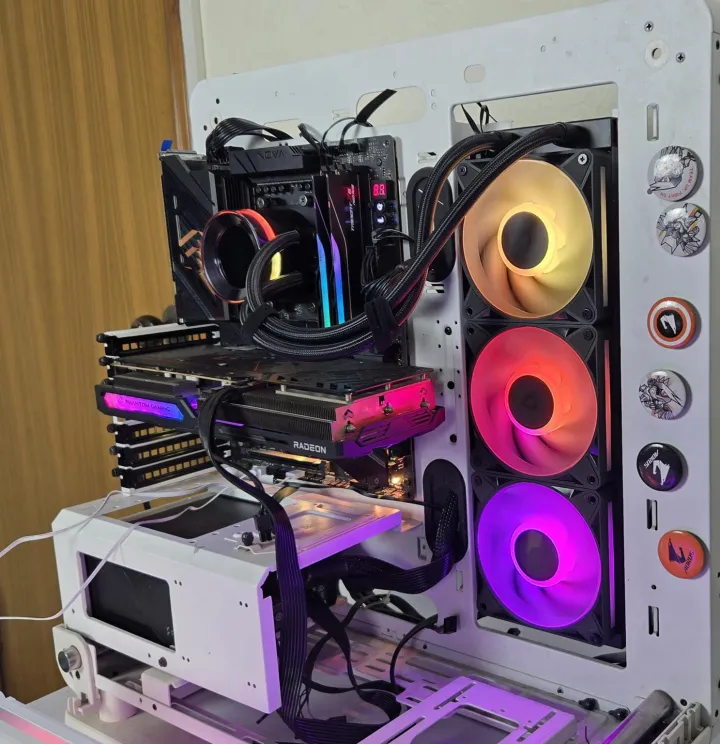
ARCTIC built its reputation on cheap coolers that don't look cheap, and it's held onto that for over a decade. These fans fit right into that tradition. The review drove them on an open bench against a 243W Ryzen 9 9900X, and the BioniX P12 fans cooled the loop 2°C better than the stock ID-Cooling fans already in the AIO. That's a genuine result for something this cheap.
Keep in mind that these fans aren't quiet. At full speed they get loud, so a custom fan curve is the sensible move. There's also a power catch worth flagging. ARCTIC itself warns against stacking more than three fans on a single 1A header, and testing backs that up: three P12 fans drew 12.24W while three P14s pulled 14.04W, both over the 12W a typical 1A header can safely deliver. The reviewer's ASRock board shut down completely with three P12 fans on one header. Stick to 2A to 3A headers, and cap P14 units at two per 1A port.
Input: MelGeek Made68 Ultra V2
MelGeek has done the cyberpunk keyboard thing before, and the Made68 Ultra V2 is its most polished attempt. It's a wired 65% Hall-effect board in a Night Purple theme borrowed from Cyberpunk 2077, aiming to be both a premium typing machine and a real competitive shooter tool.
The spec sheet reads like a wish list. Flip King magnetic switches with 0.01mm actuation precision, 8,000 Hz polling across a multi-MCU setup, DoubleShot PBT keycaps, and a full aluminum chassis that weighs 1,175 grams. It stays wired, stays an F-rowless 65%, so there's no wireless and no dedicated function row.
TweakTown's acoustic stack lands this one at 52 dB on a click test, which is quiet for the category. It layers silicone gaskets, latex foam, dampener rings, and PORON to get a thocky feel without mushiness. In CS2, Valorant, and Overwatch it responds instantly, and you could honestly leave it on the desk for real writing too.
But here's the catch that ends up getting scored. MelGeek went with translucent keycaps and faint purple legends with no shine-through. Crank the backlight all the way up and those keylabels vanish. For someone who glances down mid-fight to confirm a bind, that's a real usability problem. The reviewer lit only WASD, C, and G just to keep something readable.
TweakTown: MelGeek Made68 Ultra V2 Gaming Keyboard Review
With style and gaming performance to spare, the premium and vibrant MelGeek Made68 Ultra V2 delivers a fantastic typing experience.
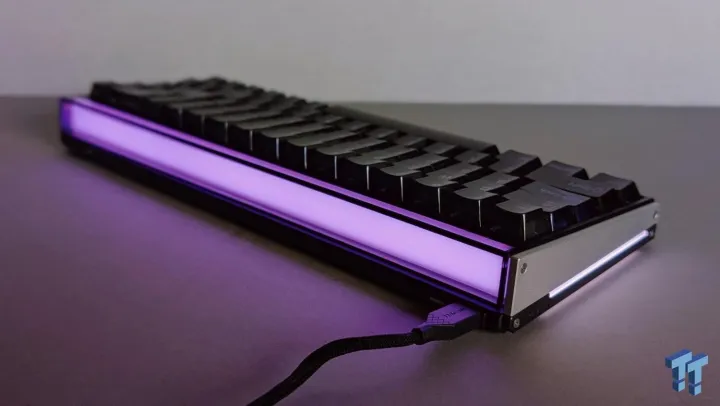
TweakTown scores it 84% overall, and Value comes in at a comparatively weak 75%. At $239 for a wired, F-rowless board, that number tells you something. It's a strong buy if cyberpunk aesthetics matter to you and you're building for reflex titles. The one thing you compromise on is readability.
Motherboards: ASRock Z890 Taichi Aqua
Now to the one with a real story. ASRock's Z890 Taichi Aqua is its flagship for Intel's LGA1851 Arrow Lake chips, and it was built in partnership with Alphacool, which is why VRM and M.2 monoblocks let you run that board through water. It landed late in the platform's lifecycle, but the price cut is what makes this review worth your time.
The spec sheet is enormous without being impressive to read. 28-phase power through Renesas controllers, four DIMM slots for up to 256 GB of DDR5, a rated DDR5-9600 overclock, two PCIe 5.0 M.2 slots plus four PCIe 4.0 ones, 10 Gbps Ethernet, Wi-Fi 7, and two Thunderbolt 4 ports on the rear I/O. It's a full EATX slab.
The cooling numbers are the headline. With the Alphacool block fitted, the VRM peaked just under 41°C, down about 25°C from air cooling and one of the coldest readings TechPowerUp has ever logged. Water-cooling that power stage pays off in a way cheap air coolers simply can't match.
TechPowerUp: ASRock Z890 Taichi Aqua Review
A monster specification with an edgy design and stunning cooling performance, the ASRock Z890 Taichi AQUA's recent discounts make it well suited for an affordable high-end system. With water-cooled VRMs and M.2 port, 10 Gbps Ethernet and plenty more besides, it's half the price of other flagship motherboards.
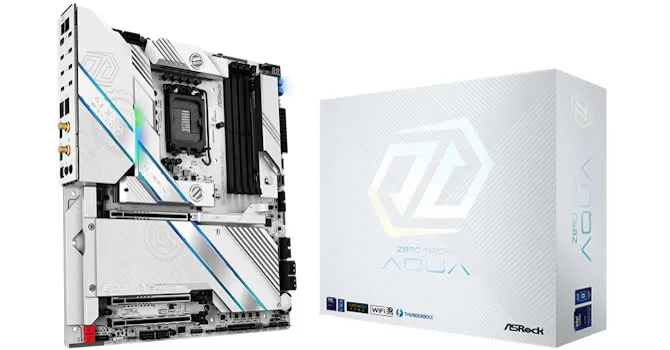
But the board arrives with real friction. Memory overclocking is described as "slow and painful," with flaky retraining after OC attempts. The EFI and software feel dated and sluggish. You need a Type-C-compatible USB stick for BIOS Flashback, and there are only two rear Type-A ports, both reached through an expansion bracket. It's a spec monster that undersells its own practicality.
The trade-offs get swallowed by the price, though. At roughly US$500 excl. tax, this is about half what competing flagships ask. TechPowerUp lines it up against the Gigabyte X870E Aorus Master X3D Ice and the MSI MEG Z890 ACE, both notably pricier. The board earns a Recommended award, closing with a straight-line verdict: "one heck of a motherboard for the money." If you're building a high-end Intel system and want water-cooled VRMs without the usual flagship tax, this is hard to argue with.


