Today's hardware roundup covers two new MSI cases, with the panoramic, back-connect-friendly MAG PANO 110R PZ and the feature-packed MEG Maestro 900R pulling in opposite directions. The FPS Review settles an ongoing upgrade debate, weighing the older Ryzen 7 7700X3D against the Zen 5 9800X3D to see if the jump is worth your money. Asus' 4K ROG Swift PG27UCWM OLED earns its premium billing with 240 Hz at 4K, while two outlets agree the $1059 Steam Frame is excellent hardware held back by its price. Round out the day with a brisk Sandisk Optimus GX Pro 8100 SSD, a featherweight ATK gaming mouse, and be quiet!'s quiet TKL keyboard.
Today's hardware roundup: dual MSI cases, an X3D upgrade call, and the $1059 Steam Frame
Today's roundup features hardware from full-size PC cases down to a wireless mouse that weighs less than a sheet of paper. There's a lot to get through, and a few of these products are making strong cases while others are leaving us reaching for the wallet.
MSI has been quietly building out its case lineup, and today it looks like two distinct philosophies land at once.
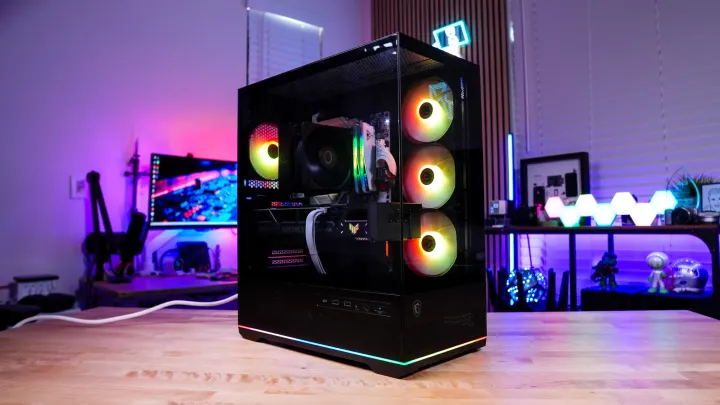
The MSI MAG PANO 110R PZ is ThinkComputers' pick for a value-conscious showcase builder. The headline feature isn't the glassy front panel — everyone did that years ago. It's the back-connect motherboard support. Alongside standard ATX, mATX, and ITX, it takes back-connect ATX and mATX boards, which is normally a premium trick. If hiding every cable behind the tray is your thing, that alone makes it worth a look at a mid-tier price.
Cooling is there too. Three 120mm reverse-blade ARGB fans on the side plus a rear exhaust, ten-fan support, a 360mm top AIO, and room for GPUs up to 400mm long. Front I/O gives you one 20 Gbps USB Type-C and two 5 Gbps Type-A. It's solidly competent across the board, and ThinkComputers calls it a strong all-rounder without calling it groundbreaking.
ThinkComputers.org: MSI MAG PANO 110R PZ Case Review
Today we are taking a look at the MSI MAG PANO 110R PZ, a mid-tower PC case built around a 270-degree panoramic tempered-glass design. It also supports traditional ATX, Micro-ATX, and Mini-ITX motherboards, as well as back-connect ATX and Micro-ATX motherboards, making it an interesting option for anyone who wants to keep visible cables to a minimum.
Then there's the MSI MEG Maestro 900R, which TechPowerUp describes as a "kitchen sink" flagship. The crown jewel is a removable motherboard tray that rotates to up to four angles in seconds. You can work on a mounted board at a comfortable angle without ripping the whole thing apart. That's the difference between a case and a build workstation.
It weighs 33 kg, runs in at a full-tower footprint of 695 x 379 x 671mm, and supports BTF back-connect boards plus water cooling on top, bottom, and both sides. TechPowerUp says it delivers on the flagship promise. The catch is the same one that runs through the whole week: a price tag around $700. It's a statement piece, not a sensible buy.
TechPowerUp: MSI MEG Maestro 900R Review
MSI has steadily improved its PC case lineup, and the MSI MEG Maestro 900R pushes boundaries even further. It goes all out on features and cooling support, and it looks every bit the flagship case enthusiasts will want, with a few extras they'll appreciate.

Whether the X3D upgrade is worth it
The most useful review in the batch isn't a shiny new product. It's The FPS Review testing the AMD Ryzen 7 7700X3D against the 9800X3D, and it answers a question every AM5 owner keeps asking.
The setup is actually ideal. Both CPUs go on the same AM5 board with an RTX 5090 so the GPU isn't the bottleneck, 12 games run at 1080p through real manual gameplay instead of auto-benchmark tools, and they track power and temperature the whole time.
The technical nuance matters here. The 9800X3D's second-gen 3D V-Cache sits underneath the CCD instead of on top, which improves thermals and lets it hold higher clocks. That fixes a real weakness of first-gen X3D. The 7700X3D is essentially a clock-lowered 7800X3D, launched as AMD's value entry into AM5 X3D gaming.
The FPS Review: AMD Ryzen 7 7700X3D vs Ryzen 7 9800X3D CPU Review
Introduction Wouldn’t it be interesting to see what kind of an upgrade the Ryzen 7 9800X3D would be over a Ryzen 7 7700X3D in 2026? We thought so too. With the recent launch of the Ryzen 7 7700X3D in July of 2026, we wanted to know what the gaming performance difference is between this his Zen 4 CPU and the Zen 5 Ryzen 9800X3D. In other words, what kind of difference is there really between a Zen 4 and Zen 5 X3D CPU, comparing AMD’s value AM5 X3D CPU with AMD’s most popular AM5 Zen 5 X3D CPU for gaming?
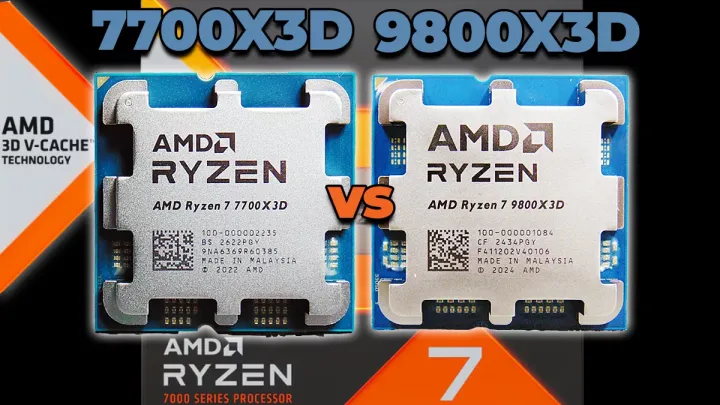
The verdict? The performance gap is real but conditional.
If you're already on a current-gen X3D, skip. If you're climbing up from something older, the upgrade is easier to justify. The forum discussion says it plainly: a Zen 3/DDR4 reader noted it "isn't the time to jump that platform." The 7700X3D's value is an entry point, not a gen-over-gen leap. MSRP sits at $329 for the 7700X3D and $479 for the 9800X3D.
A 4K OLED that runs surprisingly fast
Tom's Hardware calls the Asus ROG Swift PG27UCWM one of the best 27-inch 4K OLEDs you can buy, and it's earning that for a specific reason. Most OLEDs have to pick between pixel density and refresh rate. This one uses a tandem RGB stripe panel, two stacked layers with narrower pixels, to get both.
The result is 240 Hz at 4K, and it jumps to 480 Hz at full HD via a single-button Frame Rate Boost. Response time is 0.03 ms GTG. Panels run cooler because they're driven less aggressively, which is good for longevity.
You also get DisplayPort 2.1, two HDMI 2.1, USB-C with up to 90W power delivery and a KVM hub, Dolby Vision, and a fanless design that stays cool. There's a minor tradeoff: color volume comes in around 102% sRGB instead of roughly 110%, so sRGB modes read slightly undersaturated.
Tom's Hardware: Asus ROG Swift PG27UCWM gaming monitor review: Speed and pixel density in a premium package
The Asus ROG Swift PG27UCWM is a 27-inch 4K OLED gaming monitor with Tandem RGB Stripe tech, 240 Hz at 4K, 480 Hz at FHD, Adaptive-Sync, G-Sync, FreeSync, wide gamut color, HDR 400, HDR10 and Dolby Vision.
Asus ROG Swift PG27UCWM gaming monitor review: Speed and pixel density in a premium package

It's a premium package, and the pricing reflects that. But for someone chasing both pixel density and speed, it's genuinely hard to argue with.
The Steam Frame earns praise, not exactly wallets
Valve's Steam Frame got two serious reviews on the same day, and the consensus is remarkably aligned. That makes it a clean case study in how price can overshadow hardware merit.
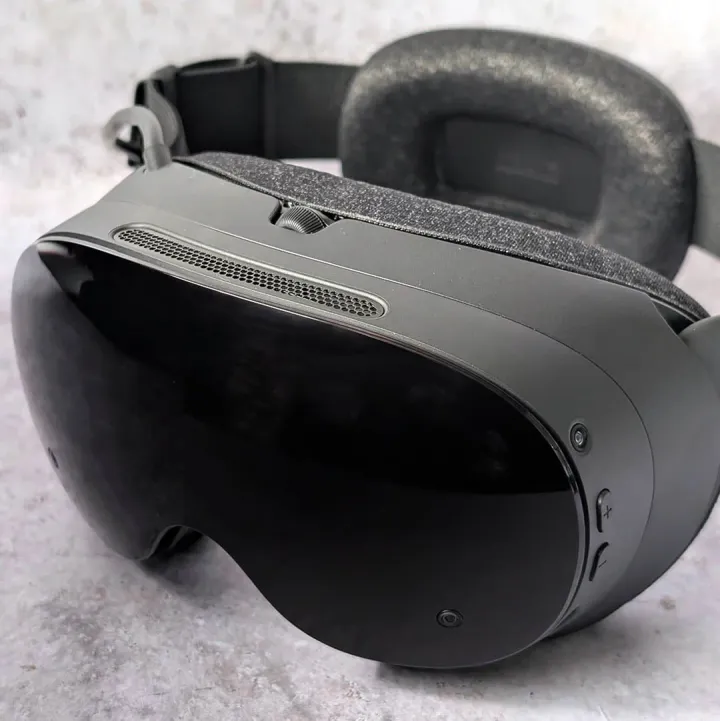
Club386 calls it fantastic wireless VR gaming at a premium. Tom's Hardware calls it competent as a standalone but says wireless streaming is the real point, with the tagline "good looks, good performance, and a debilitating price."
Both reviewers land on the same three things. The wireless streaming is class-leading, a dedicated 6GHz link with lower latency and packet loss than Meta's Air Link. It weighs 440g with a rear battery counterweight, so it's dramatically lighter than the 809g Index. And it rides on the full SteamOS ecosystem with Proton compatibility and the "Great on Frame" rating system.
The compromises show up in a predictable order. Price is the big one: $1,059 base, $1,299 for the 1TB model. Club386 attributes part of it to the RAM and SSD market crunch. Standalone performance is decent but compromised by the Snapdragon 8 Gen 3, Cyberpunk 2077 is unplayable, and Half-Life: Alyx runs around 36fps locally. Passthrough is monochrome, and there's no tethered VR option at all. Valve is fully committed to wireless.
Club386: Steam Frame review: fantastic wireless VR gaming at a premium
Valve has crafted an excellent wireless VR headset for gaming with the Steam Frame, but this unique system carries a large cost.
Steam Frame review: fantastic wireless VR gaming at a premium | Club386
Tom's Hardware: Valve Steam Frame Review: Competent as a standalone VR, but wireless streaming remains the focus
Good looks, good performance, and a debilitating price
Valve Steam Frame Review: Competent as a standalone VR, but wireless streaming remains the focus

The bottom line both reviewers reach is simple. Valve built something good. The problem is that "something good" costs a lot.
Mice, keyboards, and one surprisingly brisk storage drive
The ATK Blazing Sky F1 V3 Extreme+ is a 36g wireless FPS mouse with a hole-free symmetrical shell and the PAW3955 Master sensor rated at 40,000 DPI. It polls up to 8kHz through the new GEM 8K dongle. EnosTech found it comfortable for claw and palm grip, with crisp clicky buttons and smooth tracking in Warzone and Battlefield 6. It gets a Recommended Award, though the price sits a little high at around £75.
EnosTech.com: ATK Blazing Sky F1 V3 Extreme+ Review: A Lightweight Wireless Gaming Mouse
ATK Blazing Sky F1 V3 Extreme+ features a 36g design, PAW3955 Master sensor, 8000Hz polling, 0.163ms latency, Omron optical switches, and ATK HUB customization.
ATK Blazing Sky F1 V3 Extreme+ Review: A Lightweight Wireless Gaming Mouse - EnosTech.com

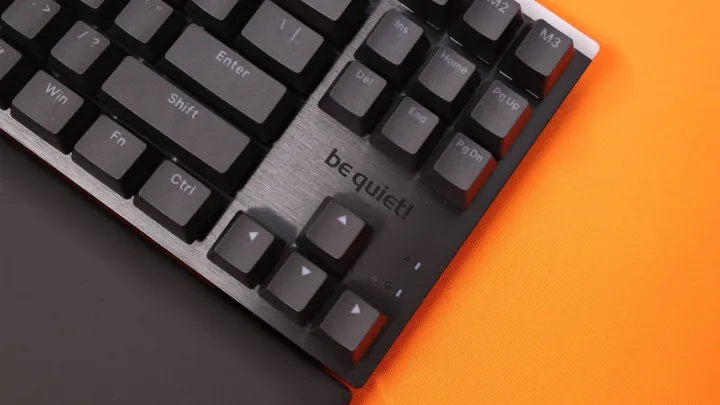
.The be quiet! Light Mount TKL is the deliberate counterpoint: a wired, quiet, 87-key keyboard. Orange linear Silent V2 switches, hot-swap, PBT keycaps, brushed aluminum, and three layers of foam damping. Hardware Busters highlights the two things be quiet! actually cares about, typing noise and build quality. It comes in at $139.90 and feels like reasonable value.
Hardware Busters: be quiet! Light Mount TKL Mechanical Keyboard Review
be quiet! Light Mount TKL review: we test its Silent V2 switches, typing noise, build quality, RGB lighting and IO Center software.
be quiet! Light Mount TKL Mechanical Keyboard Review - Hardware Busters
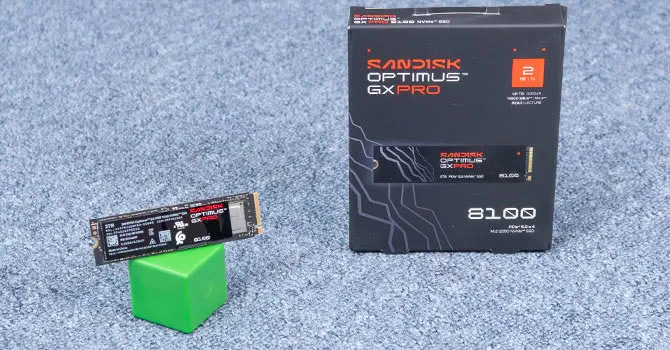
On storage, TechPowerUp runs the Sandisk Optimus GX Pro 8100 in 2TB. It's technically identical to the WD_Black SN8100 before the SanDisk/Western Digital split — Silicon Motion SM2508 controller, Kioxia BiCS8 NAND, 2GB DRAM cache. The main change is branding; it's the first consumer SanDisk SSD after the split. Performance is top-tier with a large SLC cache and efficient operation. The critique is squarely on price at $550 for 2TB, or $275 per TB. Buy for speed, hesitate for value.
TechPowerUp: Sandisk Optimus GX Pro 8100 2 TB Review
The Sandisk Optimus GX Pro 8100 2 TB is the company's new flagship, replacing the legacy-branded "WD_Black" SN8100. Under the hood, it's the same drive, and it still delivers top-tier real-world speed, a huge SLC cache, and very efficient operation, if only the pricing were better.
The theme worth remembering
Look across all eight and the through-line is clear. Premium pricing is everywhere, and reviewers keep coming back to the same phrase: great hardware, painful price.
The Maestro 900R, the Asus OLED, the Steam Frame, the SanDisk SSD, all flagged for price. Cable management is another quiet signal, with both MSI cases advertising back-connect support. And the X3D question mirrors the Steam Frame story in a funny way: the gains are real but conditional on where you're starting from. Upgrade logic is increasingly about marginal gains, not generational leaps.


