Visual Studio Code 1.148 wants your agent to keep working while you step away
Microsoft's newest Stable build treats AI agents as long-running coworkers, not chat-box novelties.
Visual Studio Code 1.148 shipped today as a Stable release, and its whole premise is dead simple. Microsoft wants its Copilot agents reliable enough to leave running while you go make coffee, take a call, or honestly, sleep. The release packs features around staying awake, reclaiming disk space, isolating work in Dev Containers, and closing a performance gap developers have grumbled about for months.
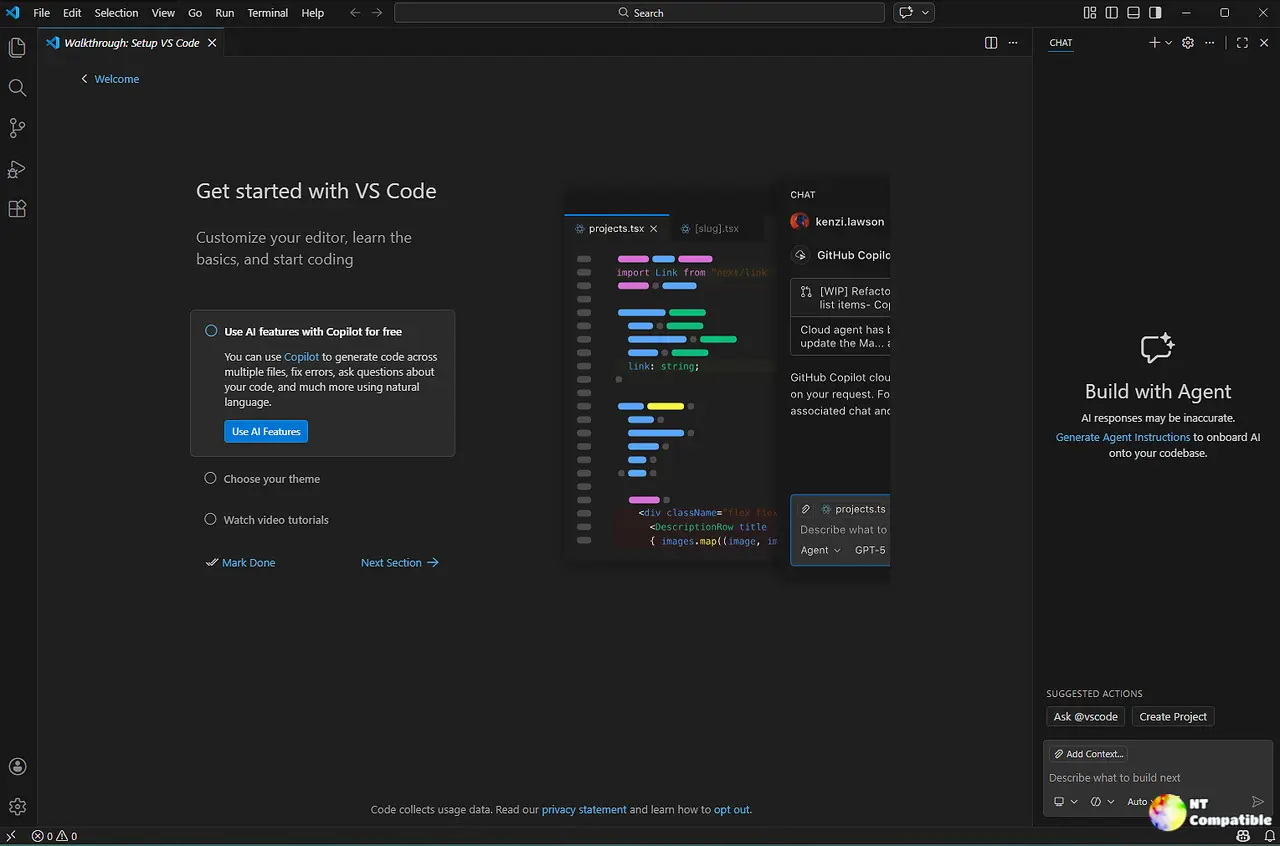
Microsoft's stated theme for the build is terse: "Keep agent work moving, even when you step away." It's the payoff of a saga that got a little ugly en route. Over the past several releases, Microsoft quietly swapped its old "Local" agent harness for a new "Copilot harness" riding a shared runtime. The change drew heat, mostly over startup lag and a felt loss of the in-editor, collaborative vibe. Now comes 1.148, whose headline claim is that agent chat starts about 30% faster and is back within roughly 5% of that old harness.
Keeping the agents going
One of the more mundane headaches with unattended agents is that they just stop. Close the laptop lid and the session tucks into sleep mode mid-task. The new prevent idle sleep setting, sessions.keepAwakeWhileWorking, lets a supported Agent Host hold the host machine awake during active turns, even after you've closed the window, then drops the hold shortly after work ends.
Three modes cover the bases. whenPluggedIn (the default) only fights idle sleep while plugged in. always keeps things awake on battery too. never restores the old behavior. It's a Preview feature, so it's feature-complete but flagged for early testing, and you can flip it on directly instead of waiting for an experiment to auto-roll.
Then there's the marquee number. Microsoft says chat in the Agent Host now begins responding about 30% faster than the previous Stable build. More importantly, start times are reportedly back within ~5% of the old Local harness. That admission is the interesting bit, since it concedes the shared-runtime transition produced a real slowdown. Microsoft is framing 1.148 as closing most of that gap and promising more.
Agent parallelism is another wrinkle. When agents run concurrently, VS Code sprouts separate worktrees to keep edits apart, and they pile up. 1.148 extends worktree cleanup so it can reclaim space on connected remote Agent Hosts, with rows and confirmations naming the owning host. Cleanup is now reachable straight from the Chat view or Command Palette (Chat: Open Worktree Cleanup), not just the Agents window.
Two experimental settings let you spin up Ubuntu Dev Containers with an Agent Host inside, files parked in a Docker volume, created locally or on an SSH host, WSL distribution, or Dev Tunnel with Docker. A handoff flow even lets the agent itself build a container from an active session, then continue inside and report back. It's a genuine step toward self-sandboxing workflows.
Beyond the agent
The release touches plenty of everyday ground too. The Remote Environments editor got a refresh with a table showing status, last activity, and OS at a glance, plus a search filter. When a connection fails, a new Troubleshoot page explains what broke, offers fixes, and can collect a diagnostic report.
MCP apps now get a fullscreen button, and the integrated browser can take a settable user agent plus HTTP Basic auth. There's a new experimental tab button, a reorganized hint list for untitled files, and the piece that's arguably the most technically spicy: a Rust diff engine compiled to WebAssembly. Microsoft says it computes diffs more than 2× faster at the median with fewer slow-tail timeouts, a gap you'd notice reviewing several heavily modified files at once. Toggle it with diffEditor.diffAlgorithm = "advanced-wasm".
Password prompts deserve a mention. Commands like sudo, ssh, and git previously died because agents run without an interactive terminal. Now the prompt surfaces as a question in chat, and the answer goes only to that program, never to the model. Autopilot-style prompts that nobody can answer simply get canceled.
The Rust CLI is about 40% smaller, and Agent Host Protocol 1.1.0 rounds out the engineering. Forty percent smaller is a weird headline for a command-line tool, unless you've been waiting on a slow SSH boot three times a day, in which case it just means your coffee stays hot. The protocol update adds TCP port forwarding, session migration with per-chat harness selection, and SEP-2640 Skills over MCP. And while 1.148 introduces no new deprecations, it carries one: the Local harness is now slated for removal in February 2027, unless an organization restricts it.
The backstory helps, though, if you want to understand why 1.148 leads with speed. A November 17 blog post by Connor Peet and Rob Lourens laid out the old problem: agents were tied to a single window's lifetime. Close the window or update the editor and every agent stopped; go remote and you hit an extension host locked against your local version. Each Copilot product built its own one-off integration to keep sessions alive. The Copilot Chat extension alone had grown past 400,000 lines of TypeScript over more than three years.
The answer is the Agent Host Protocol, an open standard around URI-identified channels, with a reducer-based state object meant to keep reconnection and replay reliable. The same protocol now powers agents across VS Code, the Copilot app, mobile, and cloud sandboxes, so a session started on a phone can continue on a laptop.
Microsoft has data to defend the swap. Against the Local harness, the Copilot harness reportedly uses 14.2% fewer tokens per device, 7.7% fewer model requests, and 9.6% lower estimated cost. Keep in mind those figures are per active device, which is why they matter most for teams juggling several agents at once. Offline DeepSWE benchmarks (12,845 comparisons across seven models) showed fewer errors, fewer hangs or crashes, and higher task completion.
The friction was real, though. First-request latency and the loss of that "AI working alongside me" feel pulled GitHub issues all through mid-November. Microsoft's own blog admitted sampled first-request latency still had room to improve, which is exactly the gap 1.148 claims to have mostly closed.
Head here to download the release.


