ReactOS 0.4.16 lands with graphical installer, Server Core, and Wine 10 sync
The open-source NT clone closes its biggest usability gap in nearly three years of development, though it remains alpha software.
ReactOS 0.4.16 has arrived, and it does something the project has debated for years: it finally ships with a graphical installer. Released August 29, 2026, the new version consolidates the live CD and boot CD into a single image. You'll no longer need to fumble through a text-mode setup wizard on a green-and-black screen. The new installer looks and feels much more like Windows.
The release branch forked from commit bac97c5 on April 28, 2026. Over the following 18 months, the team closed 381 Jira issues and pushed 2,808 commits. The oldest issue resolved? CORE-3804, opened February 3, 2009. That's 17 years in the making.
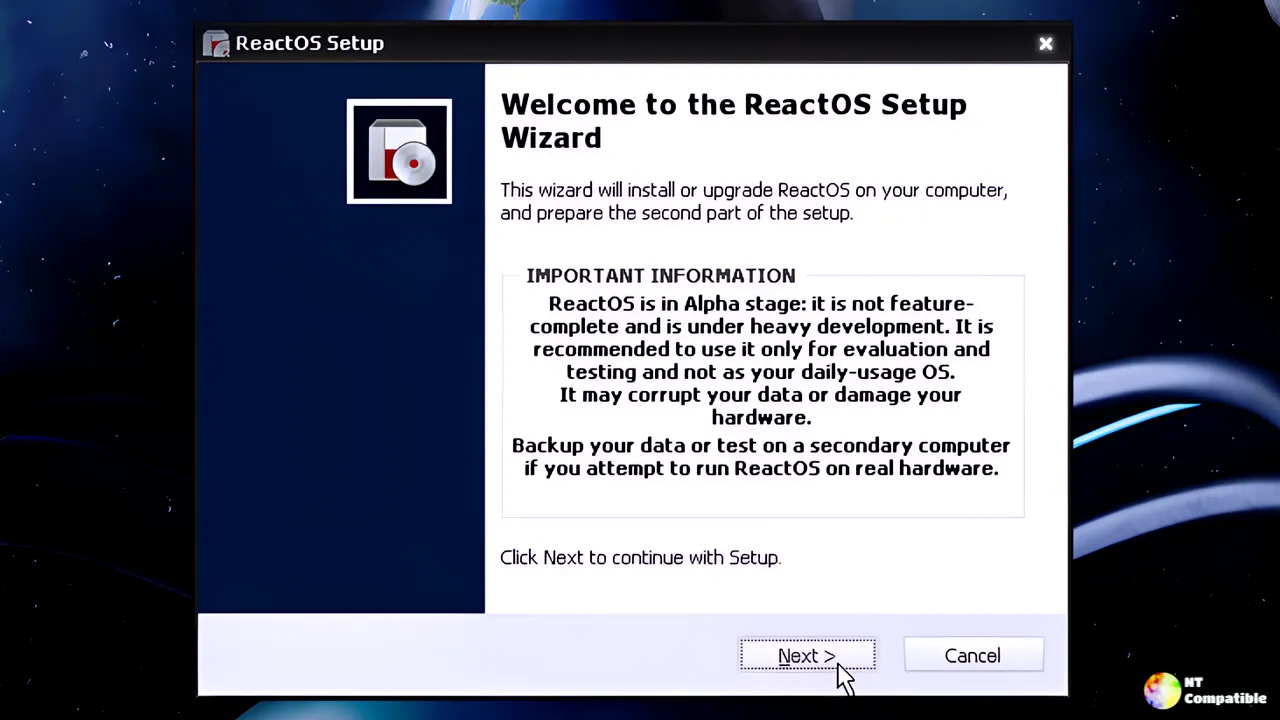
The graphical installer
The setup wizard is the work of core developer Hermès Bélusca-Maïto, who was contracted by ReactOS Deutschland e.V. back in September 2023 with one goal in mind. The effort started with syncing setupapi.dll from Wine, a module ReactOS has forked since 2005. That required fixing internal winesync.py scripts and untangling some messy Python dependencies.
By late 2023, Bélusca-Maïto had rewritten the partitioning code to support GPT and MBR layouts with a wizard-style interface. First end-to-end tests wrapped up in December, and the result is a familiar Windows-style flow. Pick partitions, format, copy files, reboot.
Driver and storage fixes
Hardware compatibility got a serious nudge, too. The biggest change is a brand-new ATA driver replacing UniATA, which has been the bottleneck since 2009. Contributor Dmitry Borisov built the replacement to handle more environments, including Hyper-V Generation 1. It also nukes the INACCESSIBLE_BOOT_DEVICE bugcheck that plagued so many setups.
Core developer Oleg Dubinskiy imported sklhdaudbus to bring proper HD Audio support. This also unlocked KMDF integration for future drivers. Nvidia users finally have a fix for GPU slowdowns caused by kernel page table entry exhaustion, thanks to a patch from Justin Miller. AMD owners get a fix for blank OpenGL windows via a rewrite of ExtEscape.
Server Core and Wine 10
There's a new "Server Core" installation option led by Carl Bialorucki. It strips out the Explorer shell but keeps the Win32 subsystem, targeting server and embedded use cases. Application compatibility also got a boost. ReactOS is now syncing with Wine 10.0, moving away from the Wine 2.x/3.x era. The release image still defaults to Windows Server 2003 exports, but builders can toggle -DDLL_EXPORT_VERSION for newer exports.
For the first time, release images include WineVDM, opening the door for 16-bit Windows applications. It's a significant step for legacy support.
Still alpha, still community-driven
It's a robust list of features, but let's be clear. ReactOS remains an alpha build. The developers recommend it for evaluation and testing only. While apps like Adobe Reader 9.3 and GIMP 2.6 might just work, many modern Windows applications still won't run. The audio volume sliders finally persist across reboots with HD codecs, sure, but don't expect a drop-in replacement for your work PC.
ReactOS traces back to 1998, born from the ashes of a failed Windows 95 clone called FreeWin95. The name came from an IRC chat, "react" referring to the group's reaction to Microsoft's monopoly. In the mid-2000s, the project survived a code theft scandal involving disassembled Windows XP binaries. That led to strict clean-room policies.
Head here to the official announcement. The source code is available on GitHub under GPL-2.0.


