JSAUX's FlipGo earns Tom's Hardware an Editor's Choice for its dual 16-inch touchscreens and built-in hub, though at 4.2 pounds it's a desk companion rather than a travel buddy. ID-Cooling's SL360 V2 AIO takes home a "best value" nod for its display block and strong fans at roughly $120. The ASUS ROG Maximus Z890 Apex earns praise for extreme memory overclocking and daily-driving polish, but sits $200 off launch amid questions about whether Intel still needs an Apex board. Corsair's 2026 RM1200e trades a switch from HEC to CWT OEM for better efficiency and quieter operation plus new PinProtect safety, while the SanDisk DC SN861 rounds out the roundup as a balanced 7.68 TB enterprise SSD built on a RISC-V controller.
JSAUX's Heavy Dual Screen, ID-Cooling's Budget AIO, and Corsair's Renamed PSU
Five reviews landed today, spanning displays, cooling, motherboards, power, and storage. Some are easy recommendations. One is a warning about trusting model names.
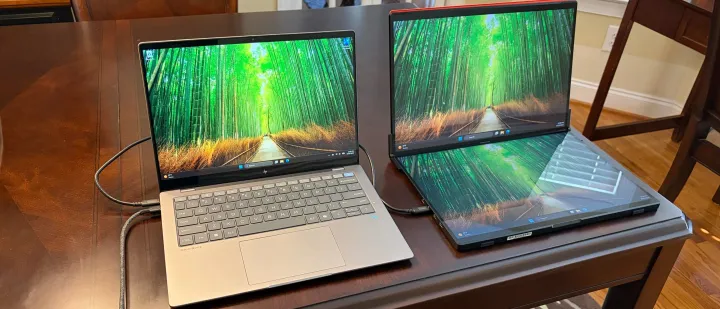
JSAUX's FlipGo is a dual-screen portable monitor. It simply isn't that portable.
The 16-inch panels fold out, touch works on Windows, and a built-in USB hub is jammed in between them. Tom's Hardware (Brandon Hill) gave it an Editor's Choice, calling it "an impeccable dual-screen portable monitor." It just added, mildly, that it's "more suited for your desk than a laptop bag."
Fair enough. At 4.2 pounds, the FlipGo tips past what most people accept as luggable, and at about $479.99 on Amazon it isn't cheap. The panels are colorful and bright, and the extra USB-A and USB-C ports are genuinely handy. It's just heavy. For a desk setup, that's a rounding error. For travel, it's the whole problem.
Tom's Hardware: JSAUX FlipGo dual-screen portable monitor review: Gorgeous displays with touch support and a built-in USB hub
JSAUX strikes again with a versatile dual-screen portable monitor
The display-block trend is clearly going mainstream now. You've seen it on premium motherboards, and as of this weekend it's on a budget AIO too.
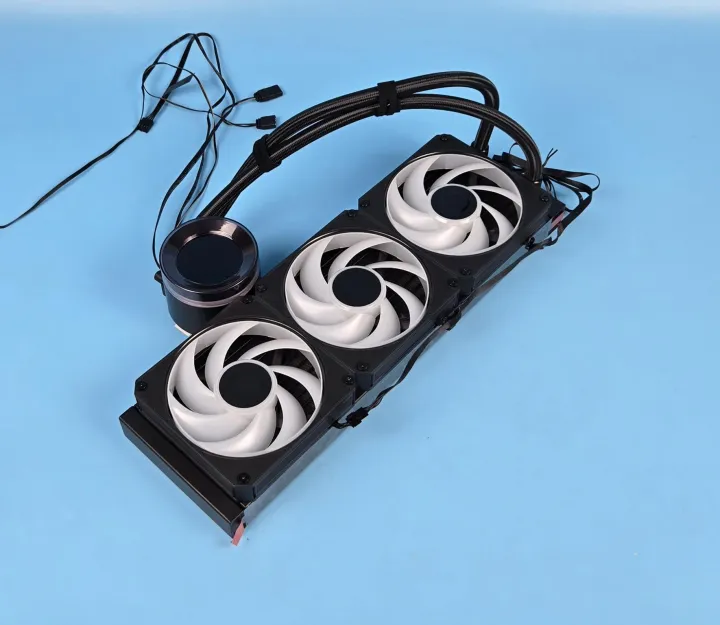
The ID-Cooling SL360 V2 is a 360mm closed-loop cooler that has no interest in being pricey. EnosTech's John S called it "possibly the best value liquid cooler on the market," and the specs largely back that up. Seventh-generation pump, ceramic bearing, fans spinning up to 2,500 RPM, and a 2.1-inch circular display on the block. It's rated for 350W of TDP and carries a three-year warranty.
The price is murky though. EnosTech lists roughly $120, but that's an estimate off a local PKR 35,000 figure, so treat it as a placeholder until someone confirms it. Performance was solid on a Ryzen 9 9900X in an open-frame bench. Annoyingly, the software wants an internet connection just to download more software, but you can tame the noise with a custom PWM curve and move on with your day.
EnosTech.com: ID-Cooling SL360 V2 Review
We are taking a look at the SL360 V2 from ID-Cooling. This cooler features a circular display screen and ARGB fans. ID-Cooling offers a 3-year warranty on this cooler, and the price tag is expected to be around the USD 120 mark. I am not sure about international pricing.
Building the machine, or spending the budget
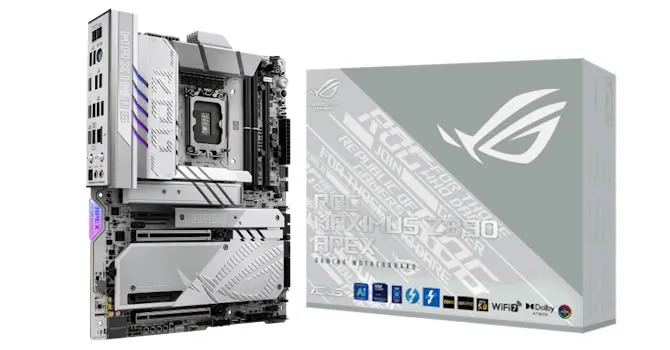
For people actually chasing memory speeds, the ASUS ROG Maximus Z890 Apex is the board. TechPowerUp's Combatus found it pairs "hardcore overclocking support with plenty of daily-driving polish," which reads like marketing copy but happens to be true here.
Two DIMM slots, a 22-phase VRM built on Infineon chips rated at 110A each, and support for DDR5-9600 in overclocked modes. It throws in tool-free M.2 installs, Thunderbolt 4, and Wi-Fi 7. It's also $200 cheaper than launch price, which matters more than the ninth fan header.
The real question TechPowerUp poses is whether Intel even needs an Apex board anymore. The AM5 variants have outsold their Intel counterparts, and AMD's platform is doing fine on its own. So this feels less like a fresh need and more like a statement of intent. If you want to crank memory frequencies to embarrassing levels on Arrow Lake, though, this is still the tool.
TechPowerUp: ASUS ROG Maximus Z890 Apex Review
ASUS ROG Maximus Z890 Apex pairs hardcore overclocking support with plenty of daily-driving polish, making for a compelling package. With the famous Apex series now on AMD's popular AM5 socket for the first time, is this Intel LGA1851 board redundant, or a bargain?
Then there's the cautionary tale. The Corsair RM1200e you buy today is not the unit Corsair sold in 2023, or even the one from early 2025. igor'sLAB (Igor Wallossek) opened up the 2026 revision and found the model name now masks three electrically distinct power supplies. HEC built the older ones. Channel Well Technology (CWT) built this one.
That switch is why the numbers shifted. The CWT version is more efficient and quieter than the HEC predecessor, earning a Platinum rating at 91.6% average efficiency and a near-silent 22 dB(A). But it also has higher ripple on the minor rails and a shorter hold-up time than some rivals.
The genuinely interesting addition is PinProtect. The 12V-2x6 GPU connector now monitors each of its six power contacts individually, tested at 12A per contact. Given the history of 12V-2x6 connectors melting and causing trouble, that's a real safety win. Keep in mind that it isn't the full PinProtect+ package with iCUE, and it doesn't remove the need to fully seat your cables. Ten-year warranty, though, so Corsair is standing behind it.
IgorsLAB: Corsair RM1200e 2026 Review: More Efficient and Quieter
The second-generation Corsair RM1200e is more efficient and quieter than its predecessor. PinProtect adds protection, but filtering performance has declined.
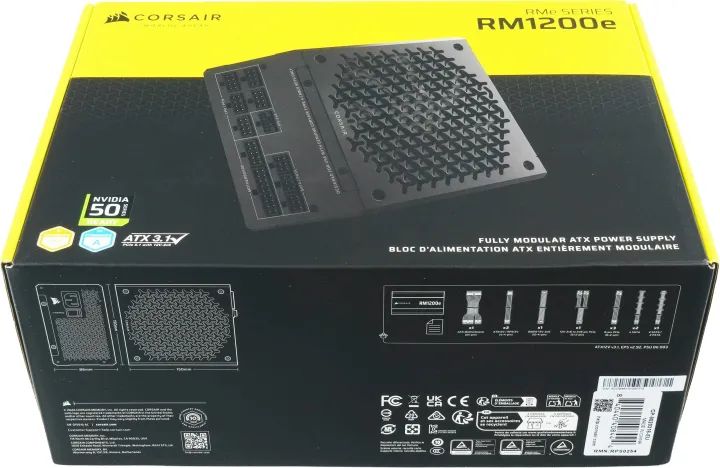
If you're comparing reviews of older RM1200e units against this one, remember: those numbers belong to a different power supply. Same name. Different guts.
Enterprise-grade
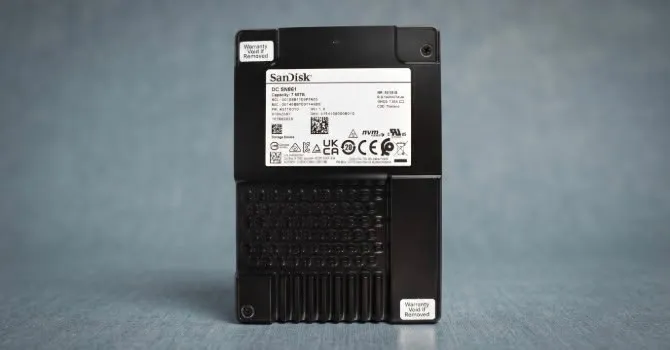
Then there's the SanDisk DC SN861, a 7.68 TB datacenter SSD that will make your typical buyer's eyes glaze over. That's fine. It's not for them.
It's built on FADU's FC5161 controller, which is a RISC-V design, paired with SanDisk's own BiCS6 TLC NAND. The interesting bit is the RISC-V architecture, quietly reflecting the industry's move toward open-standard controllers that split the heavy compute work from the low-level plumbing. SanDisk is riding that wave.
The numbers are strong. 13,700 MB/s read, 7,500 MB/s write, 3.3 million random reads, 14,016 TBW of endurance, five-year warranty. It targets the high-performance datacenter segment, so pricing is whatever the market will bear. SanDisk had it around $3,900 at review time, but enterprise SSDs swing between $3,900 and $8,000 depending on who's buying and how desperate the datacenters are feeling.
TechPowerUp: Sandisk DC SN861 7.68 TB Review
The Sandisk DC SN861 introduces a fresh PCIe 5.0 enterprise platform built around FADU's FC5161 controller and Sandisk BiCS6 TLC 512 Gb NAND. It delivers solid all-around performance with decent write power efficiency, making it a well-balanced solution for modern datacenter workloads.