Five hardware reviews, and value is the story across most of them
Five recent reviews have arrived across four categories, and if you look for a single trend, it's easy to find one: most of these products are fighting each other on price-to-feature. The monitor in the group earns its spot a different way, by matching a rival spec-for-spec.
You've got a $95 power bank that chills itself with liquid, a gaming headset you could run for weeks without charging, a full-tower case with a spinning fan cluster up front, and a 34-inch QD-OLED that TweakTown is calling one of the best around. That's a full plate. Let's work through it.
Chasing value
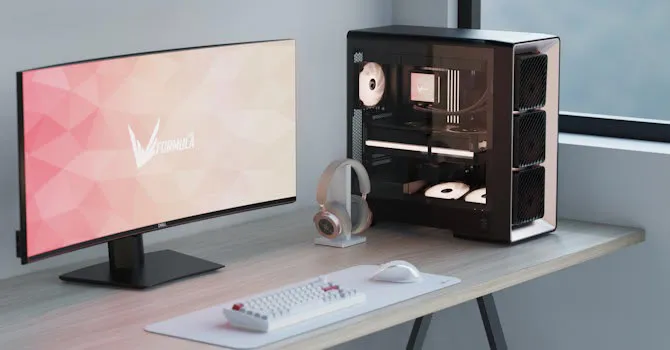
Start with the Formula V Line Air Power G10. TechPowerUp calls it the company's "showstopper," and it pulled a crowd at Computex earlier this year. What actually makes it memorable is the protruding, rotating trio of 120mm fans on the front. It's a full-tower box in steel, plastic, and tempered glass, measuring 489 by 235 by 500mm, with a motherboard tray built for BTF-compatible layouts that put the connectivity on the back side.
The price lands under $100, which is where the interesting tension lives. Five RGB fans come in the box, including one dedicated GPU fan you usually have to buy on your own. Radiator support runs up to 360mm on the top and side, and clearances read 182mm for the CPU cooler, 420mm for the GPU, and 160mm for the PSU. It's a rather ambitious package for the money, though the included fans and BTF support do a lot of the heavy lifting.
TechPowerUp: Formula V Line Air Power G10 Review
Formula V Line's showstopper case, the Air Power G10, has landed and it's certainly a looker even before considering its unique features and unusual layout. Equipped with five RGB fans, one dedicated to the GPU, it aims to wow in terms of cooling, but does the sub $100 price tag mean it's cut too many corners?
The Endorfy Viro Wireless is a different kind of value play. Endorfy spun out of SilentiumPC in 2022, mostly known for cases and power supplies, and this is its shot at gaming headsets. The pitch here isn't RGB or a fancy codec, it's battery life. Endorfy claims up to 240 hours on Bluetooth and 130 hours over 2.4GHz. At €87, it undercuts the HyperX Cloud III Wireless by roughly €40, and that HyperX hands you about half the battery in return.
53mm dynamic drivers, 354 grams, brushed-metal ear cups hanging off an aluminum frame. A hybrid mode keeps it on 2.4GHz to your PC while pulling calls from a phone over Bluetooth. The Windows "Viro Studio" app adds an equalizer and a virtual 7.1 surround. What you don't get is a carrying pouch or spare earpads, though the box is tidy otherwise. A headset that lasts weeks on a single charge is a genuine differentiator, and €87 makes the trade-offs easy to live with.
TechPowerUp: Endorfy Viro Wireless Review - Forget the Charger
The Endorfy Viro Wireless is an €87 gaming headset you'll only need to charge every couple of weeks, not days. It also offers a hybrid 2.4 GHz + Bluetooth mode for taking calls while gaming, a USB-C dongle and a detachable ENC microphone. But is its sound and overall execution as impressive as its stamina?

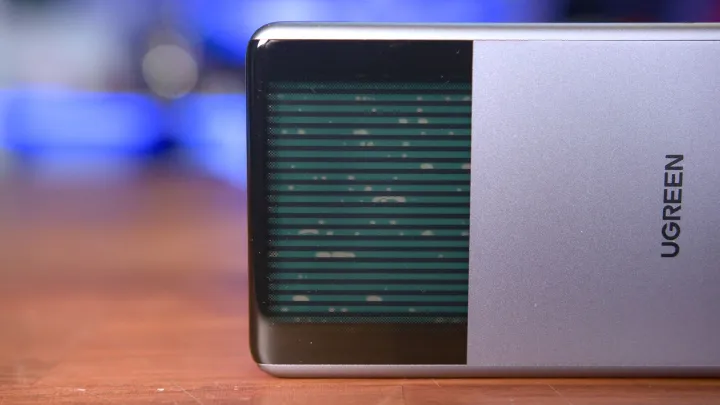
Then there's the UGREEN MagFlow Pro, which is earning two reviews this week from APH Networks and eTeknix. It's a 10,000mAh magnetic power bank that actively cools itself with a micro-pump liquid system. eTeknix leans hard into that CryoPulse pump, which cycles coolant behind a transparent front window to hold temperatures down and keep charging rates steady. APH actually ran the bench numbers, and an iPhone 17 charged through the built-in USB-C cable hit 91.5% efficiency, while Qi2 wireless landed at a lowly 56.3%. Self-recharging from 20 to 80 took an hour and 20 minutes.
At around $95, down from a $150 MSRP, it's "loaded with features," as APH puts it. There are downsides, though. It only self-charges up to 30W, the integrated cable can't be replaced (snap it once and you're left with just a strap), and the coolant pump makes an audible buzz in a quiet room. The active cooling is more party trick than necessity for a brick this size, but it does keep output stable over long sessions.
APH Networks: UGREEN MagFlow Pro Magnetic Power Bank Review
How often does your phone run out of battery before the end of the day? For me, it is basically never even though I use between 90% to 100% per day on average, but with a bit of an asterisk. I plug in my phone overnight, and it will be charged to my preset limit of 80%. I usually take a nap in the afternoon, which I will also plug in my phone for it to be charged to the preset limit. One could say my phone gets charged when I get charged. But what if I am out for the entire day and do not have access to an outlet to charge my phone in the afternoon? That is indeed a realistic problem -- and it happened a number of times when I was travelling out of the country a few years ago. Eventually, I borrowed a power bank, but it was frustrating as it was old, bulky, and did not support fast charging. Nowadays, I usually have my Apple MacBook Air in my backpack, so I just use that as to give my phone a mid-day boost when there is no outlet around. But what if I am going somewhere and I do not way to carry a $2000 laptop with a 15" screen just to charge my phone? Well, let us go back to the portable charger. I want something that is compact, can charge my phone enough times, and do so quickly. The UGREEN MagFlow Pro Magnetic Power Bank promises to do all of the above, plus a few tricks like Qi2 wireless charging and liquid cooling to keep its own temperature down. How well will it perform in the real world? Read on to find out!
UGREEN MagFlow Pro Magnetic Power Bank Review (Page 1 of 4) | APH Networks
eTeknix: UGREEN MagFlow Pro Liquid Cooled Magnetic Power Bank Review
UGREEN continues to dominate the mobile charging market, with an incredible range of power banks, cables, charging docks and so much more, and a wealth of positive user reviews and sales on platforms…
The monitor standoff
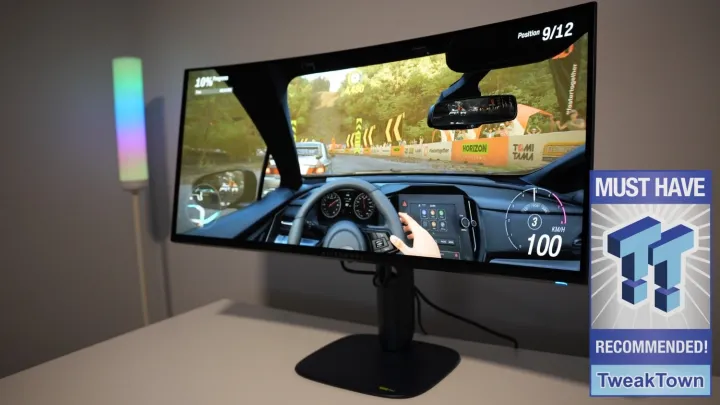
Now for the Alienware AW3426DW, which scores 91 percent and a "Recommended" at TweakTown. It's the latest step in Alienware's 34-inch QD-OLED ultrawide line, a family that kicked off with the AW3423DW back in 2022. The dimensions haven't moved, still 34 inches, 3440 by 1440, 21:9, but the panel has. It uses Samsung's new Penta Tandem QD-OLED with a five-stack emissive design that pushes more brightness while stressing the OLED material less. A fresh V-stripe subpixel layout aligns with Windows RGB rendering, which largely kills the green and magenta text fringing that bothered earlier QD-OLEDs.
The numbers are generous: 280Hz refresh, 0.03ms response in Extreme Mode, 300 nits typical and 1,300 peak, 1,500,000 to 1 contrast, 99 percent DCI-P3. VESA DisplayHDR True Black 500 and Dolby Vision HDR round it out. TweakTown says text fringing is now "almost non-existent," though it notes the display still isn't as crisp as an IPS panel if you're doing heavy word work all day.
Where it stumbles is connectivity. The USB-C port delivers only 15W with no DP Alt Mode, so you can't push video through it, and there's no KVM switch. That drags the Features score down to 80. It's arguably one of the better 34-inch QD-OLEDs available today, but those omissions keep it a hair short of the "really fantastic" tier the reviewer was reaching for.
TweakTown: Alienware AW3426DW Review: One of the Best 34-Inch QD-OLED Gaming Monitors Yet
Alienware's AW3426DW combines a 280Hz Penta Tandem QD-OLED panel with strong HDR, improved text clarity, and excellent ultrawide gaming performance.
Alienware AW3426DW Review: One of the Best 34-Inch QD-OLED Gaming Monitors Yet