Tom's Hardware found Gigabyte's $399 MO27Q2A QD-OLED to be a benchmark for value, matching or exceeding far more expensive 27-inch OLEDs. The Lenovo Pro 9n's 18-core RTX Spark is a strong machine on paper but struggles to justify its near-$3,000 price without distinct Windows features. Corsair's iCUE LINK TITAN II 360 LCD AIO earned a 9.0, while the SteelSeries Aeon Pro controller stands out as the best Elite alternative at $259.99. Budget networking from Centec and a flexible-but- pricey IceWhale Zimaboard 2 round out a week where value keeps climbing but premiums keep pushing.
A $399 QD-OLED, an 18-core RTX Spark laptop, and the LCD cooler war grinds on
Nine hardware reviews landed between November 21 and 23. Here's each one, the way they came in, including the ones that barely register and the ones worth your money.
It's roundup time again. You'll find an 18-core RTX Spark laptop, a QD-OLED monitor that undercuts nearly everything in its class, and yet another AIO cooler with a screen big enough to double as a second monitor. Some of these are steals. A couple are hard to recommend at the price.
RTX Spark still can't justify its price tag
Tom's Hardware's first look at the 18-core version of Nvidia's RTX Spark chip in a laptop. Lenovo positions it as a lighter alternative to the Microsoft Surface Laptop Ultra, and on paper it's a strong machine. The 15.3-inch WQXGA OLED, 32 GB of RAM, 1 TB SSD across two slots, and a stylus that also works as a trackstick are all genuinely compelling.
Tom's Hardware: Lenovo Pro 9n review: 18-core RTX Spark in a fancy chassis
Want something lighter than the Surface Laptop Ultra?
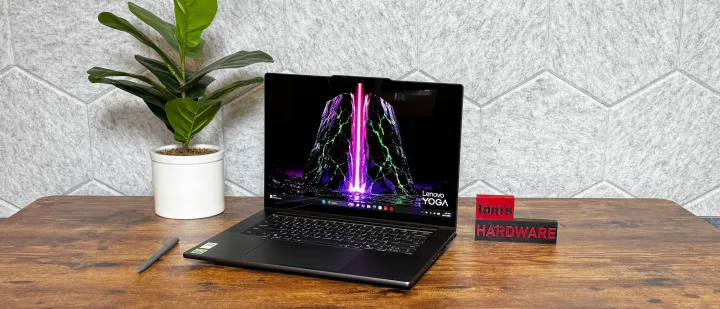
The problem is the price, and it's a big one. You're looking at $2,829 at Best Buy, drifting up to $2,999.99 at Walmart. Andrew E. Freedman's verdict was measured: it's "an elegant consumer workstation," but RTX Spark "still needs to differentiate itself with Windows features to justify that price."
That's the crux. The hardware is there. The software story isn't. Windows doesn't take advantage of RTX Spark in any way that sets it apart, and there's too much bundled software to make the premium feel earned. It's a rather expensive machine for what it actually does. The design and portability help, but an AI platform that hasn't earned distinct features shouldn't carry a near-$3,000 tag over a conventional laptop.
A few more worth your attention
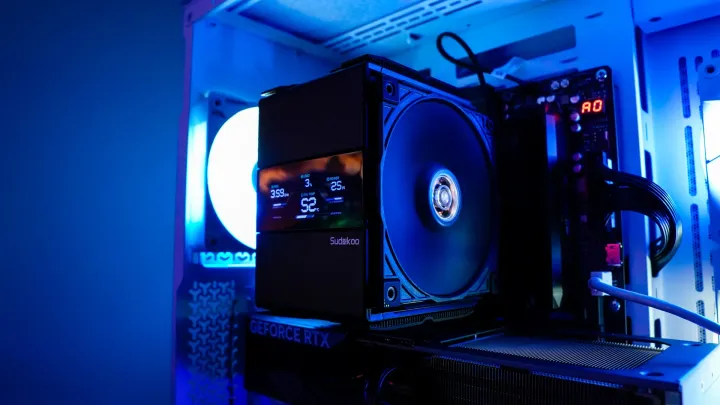
A single-tower air cooler that resists the dual-tower trend. ThinkComputers' Bob Buskirk found it builds on the original SK700V with a thicker MACH120 fan, broader socket support, and a digital readout for gaming and workstation CPUs. It moves 108 CFM and tops out at 39.9 dB(A), with a fan-stop feature that hits 0 RPM below 5% PWM.
The standout is the top-mounted VA display, showing CPU temp, usage, power, and frequency without needing third-party software. It covers the usual Intel and AMD sockets, including an AM5 offset mount.
Two oddities worth flagging. It doesn't include thermal paste, which struck the reviewer as strange given that a grease cleaner ships in the box. And at 1,470 grams it's no featherweight, though that's expected for a single tower.
ThinkComputers.org: Sudokoo SK700V Mach CPU Cooler Review
The Sudokoo SK700V Mach is a single-tower CPU cooler built around seven 6 mm heat pipes, an enclosed black heatsink, and a high-performance 120 mm fan. It builds on the original SK700V by introducing the thicker MACH120 fan, broader Intel and AMD socket compatibility, and increased cooling potential for modern gaming and workstation processors.
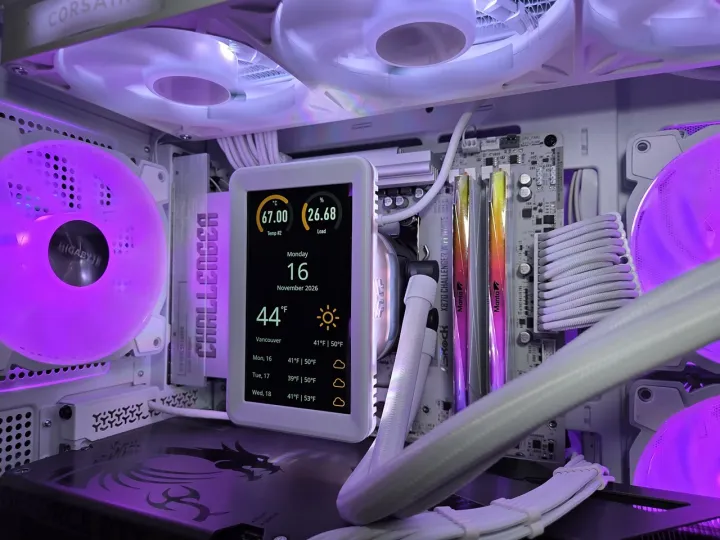
Corsair's entry into what's effectively the LCD cooler war, with its largest-ever display. Funky Kit's Winston Chim scored it a clean 9.0 out of 10. The 5-inch IPS LCD runs at 720 by 1280, shows temps and GIFs, and doubles as a second monitor. Build quality earned a 10 out of 10.
It uses Corsair's FlowDrive 2 pump and three RX360 II RGB fans on a 360 mm radiator. Mounting brackets for AM4, AM5, and Intel are included, with AM5 pre-installed. It costs $239 in the US.
The one wrinkle: rotating the LCD means remounting the pump head for orientation. And as with any single-cable ecosystem, you either love the iCUE LINK approach or you don't. There's no in-between.
Funky Kit: Corsair iCUE LINK TITAN II 360 RX LCD AIO Liquid CPU Cooler Review
The Corsair iCUE LINK TITAN II 360 RX LCD AIO Cooler features a CapSwap compatible massive 5" LCD display, a high-performance FlowDrive 2 pump, and a large 360mm radiator cooled by Corsair's RX360 II RGB fans, integrated into a unified frame. It also comes with a 70mm fan integrated inside the LCD module to help your motherboard's VRM cool.
Corsair iCUE LINK TITAN II 360 RX LCD AIO Liquid CPU Cooler Review - Funky Kit
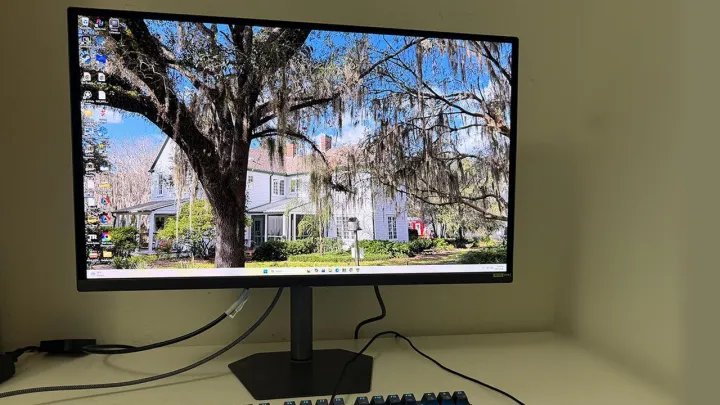
It's a 27-inch QHD QD-OLED at 280 Hz, and at $399.99 from Newegg it has Tom's Hardware handing out its Editor's Choice. Christian Eberle called it "a superlative value among 27-inch QHD OLEDs," noting that it "matches or exceeds many more expensive monitors."
You get G-Sync and FreeSync certification, HDR10, dedicated Adobe RGB and sRGB modes, USB ports with a KVM, and a mostly-metal stand. There's even a "Tactical Switch" for flipping the resolution on the fly. The only real con is a lack of RGB lighting, which only matters if that's actually your thing.
At roughly $399, this is a benchmark for value in the OLED gaming category. Near-flagship image quality at a mid-range price. OLED panels used to cost far more, so that's not a small deal.
Tom's Hardware: Gigabyte MO27Q2A 27-inch QHD 280 Hz QD-OLED gaming monitor review: Another price buster from Gigabyte
Gigabyte brings excellent value while delivering premium performance and build quality with its MO27Q2A.
beyerdynamic shipped three true-wireless earbuds at once, splitting them by use case. The Amiron 100 targets casual listeners, the 200 is an open-ear hook design for the gym and outdoors, and the 300 aims at audiophiles with LDAC pushing up to 990 kbps.
Only the Amiron 200 gets an IP54 rating. The 300 reaches into Hi-Res territory with a frequency response up to 40 kHz. Battery life runs from 35 hours on the 100 to 38 on the 300, and all three share Bluetooth 5.3, USB-C charging, and multipoint.
They're spread across price segments and form factors, so which one makes sense depends entirely on where you'd rather spend the money.
NikKTech: beyerdynamic Amiron 100, Amiron 200 & Amiron 300 TWS Earphones Review
Three earbuds, three distinct approaches to wireless listening. With the Amiron 100, Amiron 200 and Amiron 300, beyerdynamic targets everyone from casual listeners and fitness enthusiasts to users seeking a more premium true wireless experience.
beyerdynamic Amiron 100, Amiron 200 & Amiron 300 TWS Earphones Review
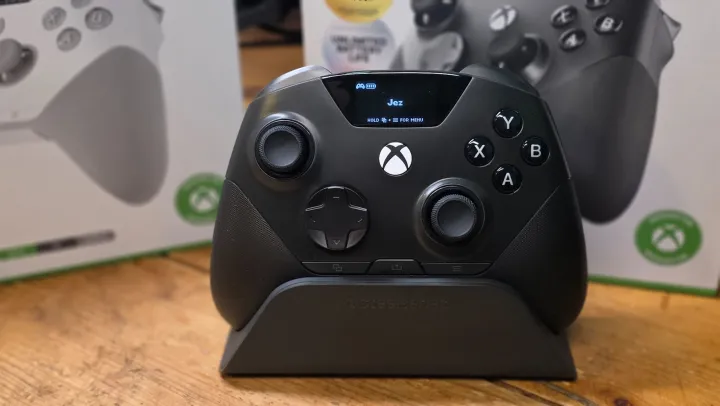
SteelSeries's first "Aeon" controller targets the Xbox Elite Series 2 head-on at $259.99 MSRP, though it often drops to $209.99. Jez Corden called it "a near-perfect Elite alternative," praising the dock that keeps one battery charging while you play the other.
You get Hall Effect sticks, adjustable trigger stops, four rear paddles, and a QuickSwitch system for flipping between Xbox and PC. The dock-centric dual-battery setup is what the reviewer called the single best feature, and it's genuinely useful for desk setups that flip between consoles.
It does have quirks though. The rear paddles are needlessly large and the inputs feel stiff until you adjust. If pure ergonomics matter more, the Razer Wolverine V4 Pro is better, but it's also pricier. An 8BitDo option sits roughly $100 cheaper with much of the same feature set.
Windows Central: SteelSeries Aeon Pro Xbox and PC Controller review — I reviewed GTA 6 with this spectacular Elite controller alternative that's near-perfect
SteelSeries' is breaking into the premium Xbox controller space, and as a fan of their headsets, it has been great to see. This first iteration of their new "Aeon" line is a fantastic first try, but I'd like to see some upgrades.
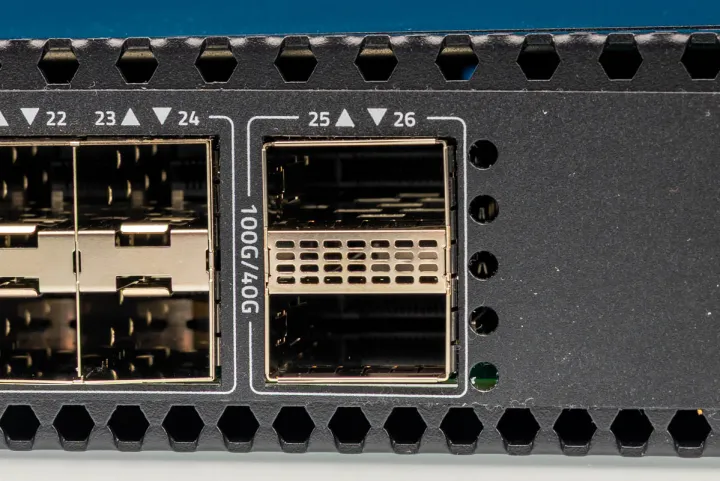
ServeTheHome bought a mystery box to test it. The Centec ZX530S-24S2CQ is a budget 1U switch built around China's Centec CTC7132 chip, sold under generic branding with silkscreened model names. At around $575 for the review unit (matching units typically land between $480 and $600), it offers 24 SFP+ ports plus two QSFP28 for 100G.
Vic A found it worth reporting, and he liked that the faceplate actually labels port speeds directly for cable planning. The switch runs CentecOS and keeps its port speeds labeled on the front.
Just be aware the exact seller has since discontinued it, though comparable units remain online. There was also a typo in the accompanying video, where power captions read "246" instead of "24.6 W." Minor, but it's the kind of thing you only catch if you're watching closely.
ServeTheHome: Centec ZX530S-24S2CQ Review The Cheap 10G and 100G Switch Option with a Centec Switch Chip
We test the ZX530S-24S2CQ switch, a 24-port SFP+ 10G switch with two 100G SFP28 ports, but with a surprise Chinese Centec switch chip inside
Centec ZX530S-24S2CQ Review The Cheap 10G and 100G Switch Option with a Centec Switch Chip
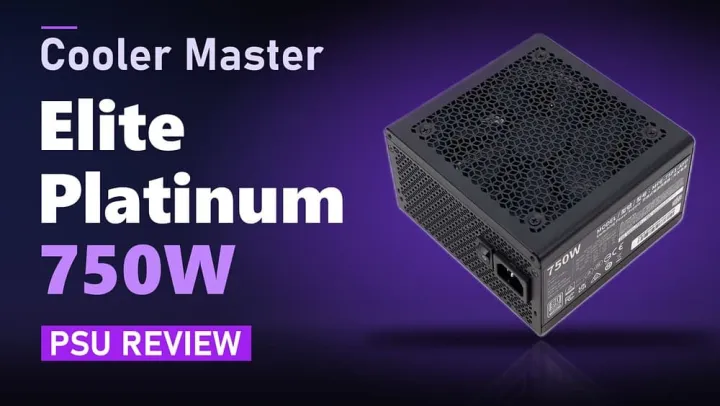
This pulls off a Cybenetics Platinum rating at 90.25% efficiency at 115V, and it runs nearly silent at 20 dB(A). Hardware Busters' crmaris scored it 7.8 out of 10, praising the 12-year warranty and strong transient performance. It's built by XHY Power and compares cleanly against 22 other 750W units.
It's fully modular, ATX 3.1 and PCIe 5.1 ready, and rates for a native 12V-2×6 connector up to 600 W. Master Gear software isn't required to run it, and a zero-RPM mode keeps it quiet at low loads.
It's held back by a short hold-up time and hot over-current protection points on the minor rails. Not yet sold in the US as of late November, so treat the pricing as tentative. A 12-year warranty is a long time to bet on a 750W unit, though.
Hardware Busters: Cooler Master Elite Platinum 750W ATX 3.1 PSU Review
Cooler Master Elite Platinum 750W review: a modular ATX 3.1 PSU with Cybenetics Platinum efficiency and Zero RPM mode, compared with 22 other 750W PSUs.
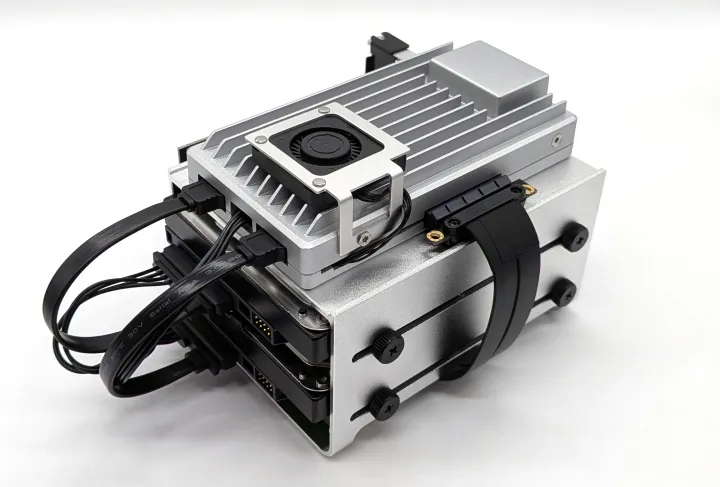
The last one is a hybrid x86 single-board computer that also does NAS duty. IgorsLAB's Tim Kutzner found it impresses on flexibility but costs more than comparable mini PCs. It's passively cooled with an aluminum enclosure that doubles as a heatsink, has an open PCIe slot, and runs ZimaOS.
The "832" variant runs about $392 with a discount code, and that includes a lifetime ZimaOS license. Power draw is tiny, sitting at 0.7 W in wake-on-LAN mode and 18.2 W under stress. It tops out around 67 degrees on the CPU under max load, and runs effectively silent.
It's not worth it if you want to run demanding VM workloads, but for tinkerers it's a solid platform. The software has rough edges though. A GUI drive format failed in testing and only worked over SSH, ZimaOS was missing MFA and scheduled SMART tests, and there's no power button at all, meaning a restart requires unplugging it or relying on Wake-on-LAN.
IgorsLAB: IceWhale Zimaboard 2 Review: NAS or SBC?
The Zimaboard 2 is a versatile, expandable NAS and homelab computer. The concept impresses in our review, but it costs more than comparable mini PCs.