Five recent hardware reviews share a common focus on thermal design and memory savings, spanning an Eversolo streaming amp, a cable-free Maingear gaming PC, a budget ASRock motherboard, and two fresh SSDs. The Eversolo Play and ASRock B860 Challenger Wifi both earn praise for hitting strong price points by trimming features like remotes or rear USB speed without harming the core experience. The Maingear Zero's reverse-connector design and the Samsung P9's conductive metal shell both turn heat management into a real selling point, while the DRAM-less Biwin M560 and Samsung P9 chase efficiency at the cost of sustained writes. Ultimately, the roundup shows that smart trimming and clever cooling now matter just as much as raw specs.
Reviews Roundup: Streaming Amp, Cable-Free PC, Budget Motherboard, and Two SSDs
Five hardware reviews from late October into early November 2026 share an odd common interest: how aggressively products are shedding RAM and managing heat.
Head to any review site this past week and you'd likely catch the trend before reading a single verdict. Pull together a $589 streaming amp, a cable-free gaming PC, a $150 motherboard, and two fresh SSDs, and the same two themes keep resurfacing. What builders are willing to cut is telling. And what reviewers are willing to forgive, even more so.
Keep in mind that these landed across four categories, from outlets including Tom's Hardware, Windows Central, StorageReview, and NikKTech. The specs vary wildly. So let's walk through them and see what actually matters versus what's just marketing.
The value plays: an amp and a motherboard that trim smartly
NikKTech handed the Eversolo Play a Golden Award, and it wasn't a free pass. The unit folds a network streamer, a 32-bit DAC, and a Class D amplifier into a single aluminum box. The reviewer says it "gets most things right." That's genuinely high praise for a $589 all-in-one aimed at passive speakers.
The numbers hold up enough for a component at this price. You get 2×60 watts into 8 ohms, or 2×110 watts into 4. Decode tops out at 768 kHz / 32-bit PCM, and DSD512 rides over USB. Eversolo is backed by Zidoo, which shows up in the software. Its Control app mirrors the 5.5-inch touchscreen and offers per-output EQ presets. Reviewers called it a category benchmark.
Two things do get cut. There's no remote, and no headphone jack. For a component this pricey, that stings. But skipping them ignores the Play's real strength: doing everything in one elegant little chassis. A purist may still want a separate streamer-DAC stack, though. If you're building a passive-speaker setup with minimal fuss, this is probably the answer. A CD Edition with an optical drive also exists for those who want physical media.
NikKTech: Eversolo Play Streaming Amplifier All In One Player Review
Combining streaming, digital conversion and amplification under one roof, the Eversolo Play is a modern all-in-one audio component designed to serve as the heart of a passive-speaker hi-fi system.
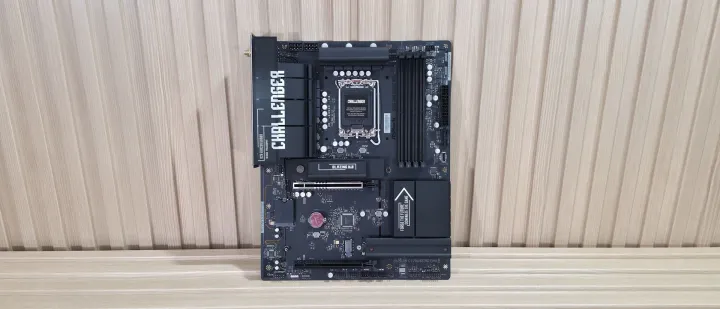
Same game, different product. The ASRock B860 Challenger Wifi lands at $149.99, dropping to about $140 on Amazon, and Tom's Hardware reckons it's one of the more solid budget ATX boards around. It runs Intel's B860 chipset for the LGA 1851 socket and, against expectations, handles a Core Ultra 270K Plus without throttling through gaming and creative work. A white variant exists too.
The compromises are deliberate, not accidental. Rear USB tops out at a sluggish 5 Gbps, the VRMs run hotter than rivals, and the BIOS feels dated. Tom's Hardware scored it "average to above average," which for a $150 board is a win. Still, you'll want decent chassis airflow if you pair it with a meaty CPU. Budget value with the corners trimmed precisely.
Tom's Hardware: ASRock B860 Challenger Wifi Motherboard Review: Entry-level ATX at a great price, with drawbacks
This Challenger is worth considering on a budget, but there are limitations to going this cheap.
ASRock B860 Challenger Wifi Motherboard Review: Entry-level ATX at a great price, with drawbacks
Beat the heat, skip the RAM: a PC, two SSDs, and the DRAM-less race
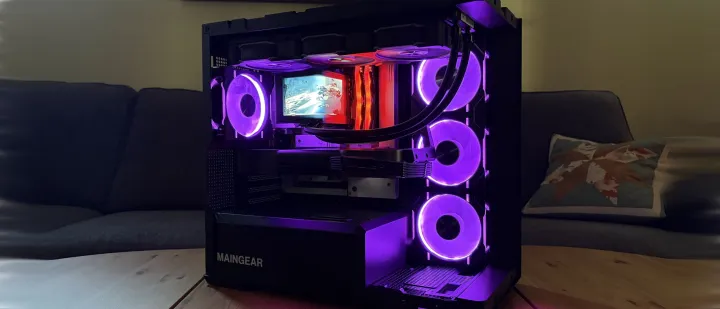
The Maingear Zero (MK.II) is the standout of the whole batch, and honestly it's more than a pretty face. Its whole pitch is MG-RC, Maingear's patented reverse-rear connectors, so cabling plugs into the back of the motherboard instead of jamming through the side panel. The panoramic glass stays clear, and the reviewer calls the reverse-connector approach "the future of PC building."
The review unit was a beast. A Ryzen 7 9850X3D and an RTX 5090 Founders Edition, 32 GB of DDR5-6000, and a 1,250 W PSU. That config ran about $8,676. Starting prices begin at $2,799 for a Core Ultra 5 250K Plus paired with an RTX 5070 and 32 GB of RAM, though. That's basically what the equivalent DIY build costs, so the boutique premium here is thin.
Thermals are where the design pays off. On stock fan curves in a 21°C room, a 20-minute stress test peaked at 50.5 dB. The RTX 5090 never topped 80°C, the CPU held around 62.5°C, and there was no throttling whatsoever. Not bad for a case that sells itself on looks.
There are wrinkles, though. The front I/O leaves something to be desired, with two USB-A ports at 5 Gbps and a single USB-C at 10 Gbps. For what it's worth, the MSI board inside actually ships USB4 and Wi-Fi 7. A loose fan connector cost the tester a couple of fans mid-review, and zip-tie cable management makes servicing the hidden wiring a nuisance. Maingear did include a LEGO figurine to prop up the GPU, which is its own weird kind of solution.
Windows Central: I spent weeks using a pre-built gaming rig with almost no visible cables. Is this the future of PC building?
The Maingear Zero is a new PC featuring the company's patented MG-RC connector, moving ugly cabling out of sight behind the motherboard. I've been using the PC for a few weeks to see if this setup has any drawbacks, and, ultimately, whether or not it's worth a buy.
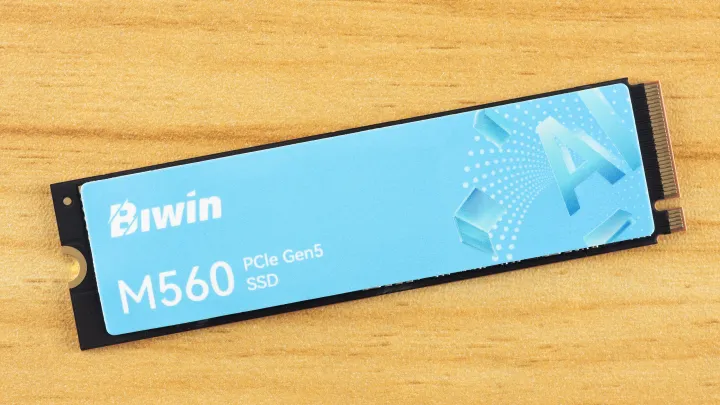
DRAM-less was never supposed to mean slow, and the Biwin M560 is proof. It's a PCIe 5.0, DRAM-less M.2 NVMe drive built on the hard-to-find SMI SM2504XT controller, and it's Tom's Hardware's Editor's Choice at $364.99 for 2 TB. "One of the best all-around PCIe 5.0 SSDs we've tested," with class-leading responsiveness and excellent efficiency.
The payoff is low latency on small reads plus strong power efficiency. The trade-off is what DRAM-less drives always surrender: once the cache fills, writes crawl. There's also no 4 TB option. For daily use and gaming, though, it's arguably the best of the batch.
Tom's Hardware: Biwin M560 2TB SSD Review: The DRAM-less drive to beat
Next-gen responsiveness without the heat.
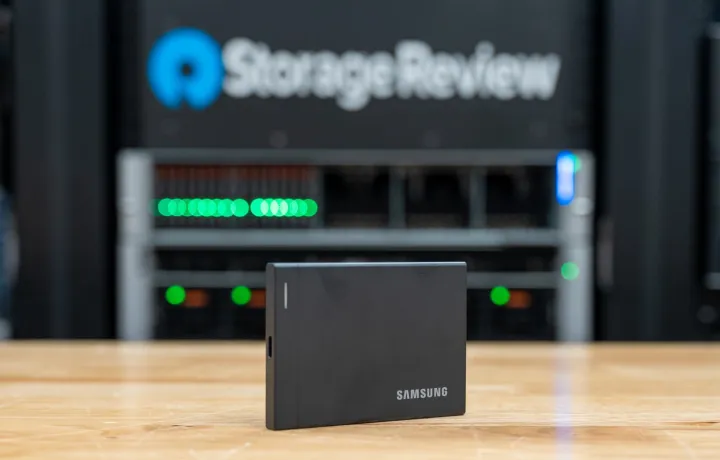
Samsung went the other way with its first USB4 portable SSD, the P9, which reads at 4,000 MB/s, double the T9 it sits above. StorageReview's Brian Beeler confirms it, hitting 4,048 MB/s in testing. The P9 also stays the coolest-running drive in the group, peaking at just 40°C. The SanDisk hit 62°C, LaCie 60°C, and Lexar 70°C. The metal shell does the cooling.
Six-fifty for 2 TB is a lot of money, so the trade-off bites on sustained writes. The cache exhausts after roughly 150 GB and drops to about 540 MB/s. It can't hold a steady 1,000 MB/s, and its tiny random writes are the slowest of the bunch. LaCie's Rugged SSD4 is the better bet if sustained write speed matters. Photographers pulling camera cards, though, get exactly what they came for.
StorageReview: Samsung Portable SSD P9 Review: 4,000MB/s USB4 Reads in a Metal Shell That Peaks at 40C
Samsung Portable SSD P9 review: 4,000MB/s USB4 reads, a 40C peak under load, and where its long writes fall behind the LaCie and SanDisk.
Samsung Portable SSD P9 Review: 4,000MB/s USB4 Reads in a Metal Shell That Peaks at 40C