Visual Studio Code 1.135 makes AI agent sessions portable and introduces a cross-model "Rubber Duck" reviewer
The new Agent Host Protocol treats your coding agent as a shared resource, letting you switch between apps while you work.
Visual Studio Code 1.135 is here, and Microsoft is making a serious bet that the editor should function as the universal runtime for AI coding agents. The release centers on the new Agent Host Protocol, an open standard that lets agent sessions move across applications without losing context. You can start a conversation in one tool and pick it up seamlessly in VS Code.
This is the kind of architecture that usually defines platform winners. We've seen this play out before with the Language Server Protocol and the Debug Adapter Protocol. Microsoft pioneered both, and they effectively locked in the editor as the standard by giving developers independence from specific tool vendors. Now they're applying the same playbook to the agentic layer.
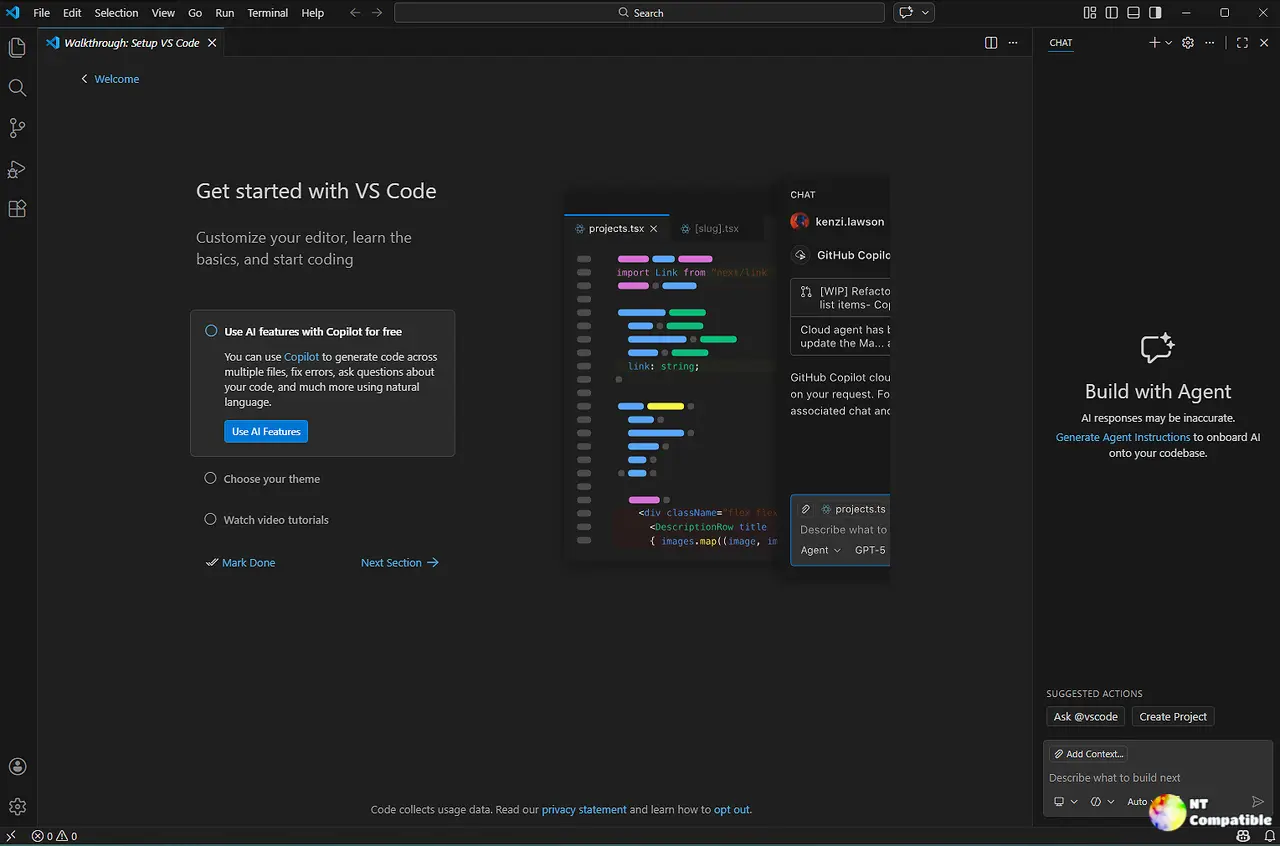
Agent Host and Cross-App Continuity
The Agent Host is a dedicated process that sits between your IDE and multiple agent backends. It owns the authoritative session state. Clients speak the new AHP protocol, while agent backends integrate directly with the host. Every change in a session broadcasts as a single monotonic, totally ordered stream. That keeps all connected clients perfectly synchronized.
The protocol relies on immutable state and pure reducers. Clients apply changes optimistically via write-ahead reconciliation, then reconcile with the server echo.
The practical result is External Agent Sessions. With chat.agentSessions.showExternal enabled by default, VS Code displays up to two recently updated sessions created in other applications. You can select any external session from the list to view and continue it inside the editor.
Keep in mind that continuing a session from another app requires a Copilot subscription. Microsoft is positioning Copilot as the glue that ties together agent sessions across vendors. The protocol normalizes state, but the ability to resume work leans heavily on GitHub's ecosystem.
Rubber Duck and Cross-Model Review
The most interesting experimental feature is Rubber Duck. It gets a second opinion from a complementary AI model on the primary agent's work. Invoke it with /rubber-duck in a Copilot agent host session, and it activates at strategic checkpoints.
When you use a Claude orchestrator, Rubber Duck runs GPT-5.4 as the reviewer. Microsoft is exploring other model pairings.
If you're keeping score, the numbers are strong. On SWE-Bench Pro benchmarks, Claude Sonnet paired with Rubber Duck closed 74.7% of the performance gap between Sonnet and Opus. For hard problems spanning three or more files with 70 or more steps, Sonnet plus Rubber Duck scored 3.8 to 4.8 percent higher than the Sonnet baseline.
It caught a scheduler that would start and immediately exit, an infinite loop in a scheduled task, and a loop silently overwriting the same dictionary key on every iteration. Rubber Duck is invoked sparingly at high-signal moments rather than after every action. It avoids noise while catching compounding errors early.
UX Overhaul and Sandboxing Reversal
The single-pane side layout is now the default for the Agents window. Settings like sessions.layout.singlePaneDetailPanel let you toggle this if you prefer the classic look. Diffs use side-by-side view when space permits, switching to inline when narrow.
Session headers are cleaner. Session information pills for changes, PRs, and issues now sit directly above the chat input.
Chat response footers now show per-model token breakdowns on hover. You can see input tokens, cached input tokens, and output tokens for each turn.
Microsoft has also reversed the sandboxing rollout for the local agent harness. It was at 50% of users for validation and has now returned to 0%. The company cites a desire to focus engineering effort on higher-priority investments, specifically the Agent Host and Copilot harness development. Sandboxing remains available as an opt-in feature.
That's a calculated call. The sandboxing feature likely introduced friction or consumed resources better spent on the core agent infrastructure.
Head here to download VS Code 1.135 or grab the nightly Insiders build. The release supports Windows x64 and Arm64, macOS Universal and Intel, and Linux deb, rpm, tarball, and snap across x64 and Arm.


