Visual Studio Code 1.140 makes AI agents the backbone of the editor
Microsoft shipped Visual Studio Code 1.140.0 on September 30. The stable release leans hard into a future the company has been building toward for years: the editor is no longer just a place to type code. It's becoming a control panel for AI agents that open files, run terminals, and file pull requests while you sit back and watch.
There's a fair amount under the hood here, and not all of it is meant for your normal workflow. Microsoft frames 1.140 as an expansion of agent workflows, worktree reuse, and enterprise AI controls. The headline move is folding the Copilot agent harness in as a first-class citizen, backed by the Agent Host architecture the company introduced back in August.
For most of its life, VS Code was just an editor. Fast startup, a small footprint, a sprawling extension marketplace. Then in 2023 Microsoft folded GitHub Copilot in and started turning the chat panel into a coding companion. Things moved from there, quickly. Inline suggestions became full agentic workflows, and last fall Microsoft layered multiple agent harnesses on top of the editor, including its own Copilot option, a Claude Agent harness built on Anthropic's SDK, and an OpenAI Codex option.
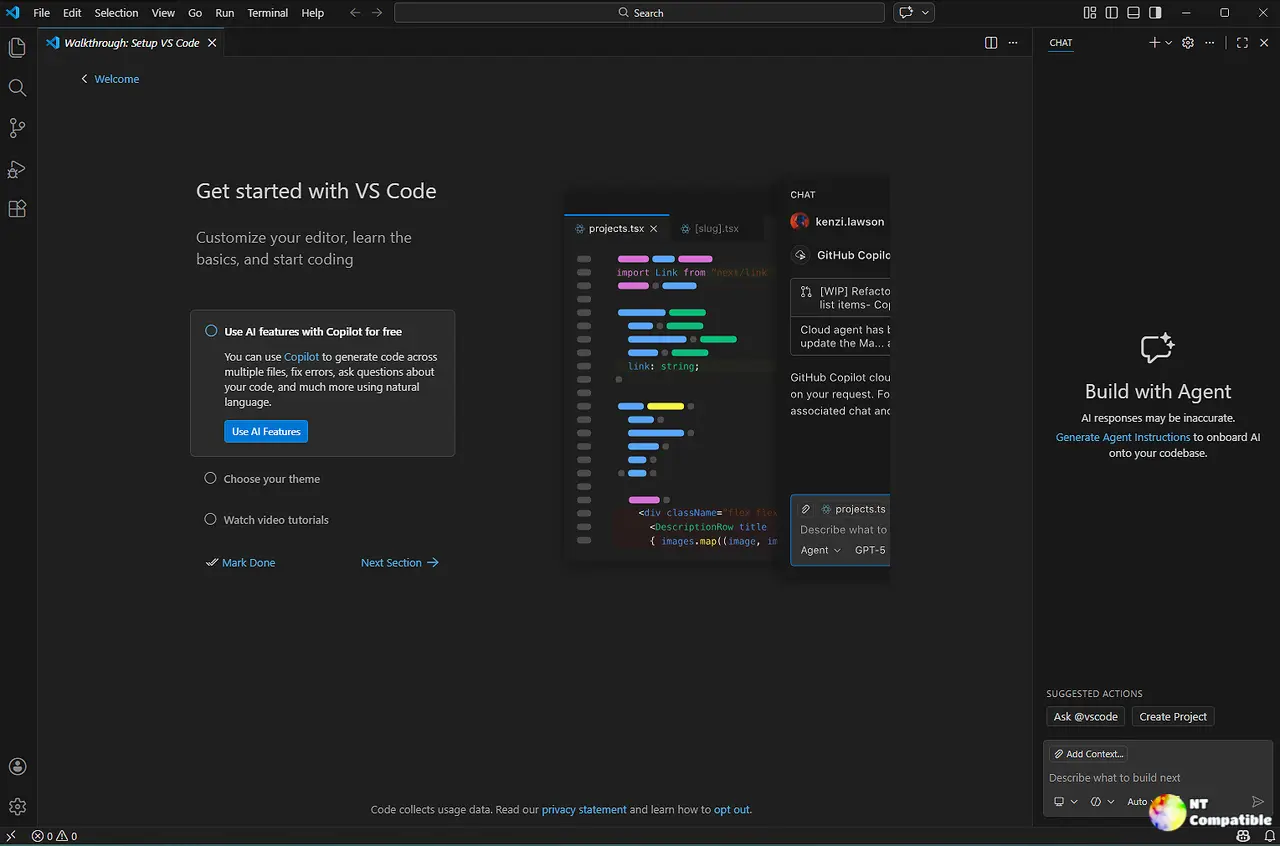
The Copilot harness goes first-class
The old design tied each agent to a single editor window. Run a session in one window and close it, and the runtime simply died. Open a second window and it had to reload all its own infrastructure. 1.140 changes that by moving the Copilot harness into a dedicated Agent Host process. Since it's built on the GitHub Copilot SDK, the behavior stays consistent with the standalone Copilot app and the Copilot CLI.
The payoff is portability. Start a task in one window, close the folder, come back a week later, and you pick up where you left off. The Agents window can monitor the same live session without making a copy. This isn't new tech under the hood. Rob Lourens, Connor Peet, and Brigit Murtaugh detailed the Agent Host and its open Agent Host Protocol (AHP) in an August blog post. 1.140 is the version that finally drags it out of the preview and onto Stable.
By the way, the version numbers follow the editor's roughly monthly cadence, so 1.140 sits directly on top of 1.139. Insiders is already tracking 1.141 for anyone who wants the nightly version ahead of the next stable milestone.
HydraFusion is the ambitious bet
The feature worth a skeptical eye is HydraFusion, now out as a Research Preview. Drawn from GitHub's Project HydraFusion, it's an adaptive system that orchestrates multiple models to draft, critique, and revise code without you lifting a finger. GitHub describes it as something that "chooses the models and workflow for each coding task."
Rather than you picking one model and hoping it's the right one, HydraFusion treats it as an optimization problem. It reads capability signals for reasoning, generation, debugging, and tool use, then picks the least complex workflow expected to clear the quality bar. It routes each request three ways: Single, where one model does the work; Cascade, where an efficient model drafts and a quality gate decides whether to escalate; and Critique, where one model drafts, an independent critic reviews it, and the drafting model revises once.
Governing AI at scale
The controls aimed at IT teams are probably what actually ships to the most machines. VS Code now explains minimum-version requirements wherever AI features are unavailable, instead of dropping a blunt "Update Required" dialog. Administrators can set a default tier for the Auto model, and a new OpenTelemetry setting lets organizations attribute Copilot data to individual developers. Microsoft also changed how managed telemetry settings resolve, applying the telemetry block from only the highest-priority delivery channel.
Visual Studio Code 1.140.0 runs on Windows, macOS, and Linux. Head here to download the release.


