Today's roundup spans six new reviews: a gorgeous but painfully expensive MSI MEF Maestro 900R case, a free Witcher 3 Path Tracing update, a near-perfect Razer keypad, a rugged FOSSiBOT phone, and two power supplies. The MEF Maestro 900R cools well and looks stunning, yet its enormous size, fiddly cable management, and a price tag that eat away at the experience. DSOGaming's benchmarks show that free update makes 4K Path Tracing genuinely playable on an RTX 5080 with Frame Gen, well under CDPR's own requirements, while the Razer Tartarus V2 Pro's 27 analog keys are brilliant despite lingering Synapse bugs. On the power side, the NZXT C850 SFX earns a 9/10 (and drops to $133 on Amazon) while the ABYSM Morpheo GX5 scores 7.8, and the FOSSiBOT F115 Ultra takes home a Golden Award for eight days of battery life at $599.99.
Today's hardware roundup: a $799 showpiece case, a free Witcher update, and two power supplies that change the SFX math
Six new reviews landed this week. Only one of them asks you to spend about $799 just to hold a PC case, but the rest are worth your attention. There's a free game update that quietly undercuts NVIDIA's own marketing, a near-perfect MMO keypad that stops short at launch, and two power supplies that make you reconsider whether SFX really has to be a compromise. Here's what the testers actually found.
The MSI MEG Maestro 900R is, by most measures, a beautiful object. Three curved tempered-glass panels frame a centre-aligned build, and it'll swallow an E-ATX board with room to spare. At 671 by 379 by 695 millimetres, it's genuinely enormous. It weighs around 38 kg even before you drop a GPU in it.
That size exists for cooling potential. Club386 ran a Ryzen 9 9950X3D2 Dual Edition against an RTX 5090 and a 360mm liquid cooler, and the numbers held up. Idle temps sat at 27°C, and the 9950X3D2 peaked at 81°C over a 10-minute Cinebench 2026 cycle. Cyberpunk 2077 pinned both CPU and GPU at 69°C. Then comes the uncomfortable cost.
Cable management is the usual suspect on a case this large, and this one delivers. The rear chamber is cramped, the motherboard's I/O and the GPU's outputs live inside the case (so you yank a panel to reach them), and the front-I/O wiring fights for the same cramped space as everything else. A build that should take an hour stretched to two.
Club386: MSI MEG Maestro 900R review: a big, beautiful case at an uncomfortable cost
The MEG Maestro 900R is a stunning and unique PC case, but you'll need loads of space, strength, and cash to build a system inside one.
MSI MEG Maestro 900R review: a big, beautiful case at an uncomfortable cost | Club386
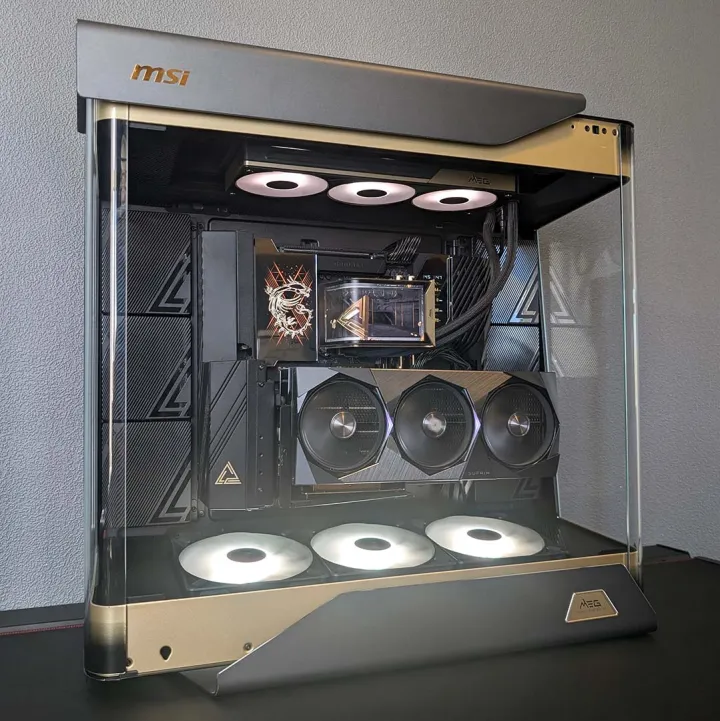
It's a rather expensive machine for the hassle it's going to cause, though the design and eye-catching aesthetics do carry it as a genuine showpiece. Club386 even suggests MSI should sell it prebuilt, which honestly sounds like the better product.
The Witcher 3 got path tracing, free
CD Projekt RED shipped a free update to The Witcher 3: Wild Hunt Remastered, adding Path Tracing to PC. That reads like a way to melt an RTX 5090, so DSOGaming went looking for the point of diminishing returns.
Their conclusion: CDPR's official 4K requirements are far too strict.
On DSOGaming's rig, an RTX 5090 cleared 70 FPS at 1440p with Ray Tracing and Ultra+ on. The RTX 5080 sat near 50 FPS and needed DLSS Quality to stay smooth. But 4K Path Tracing on the 5080 was more playable than expected, roughly 42 to 46 base FPS with DLSS Performance Mode, lifted into the high 70s once Frame Gen kicked in.
There's a wrinkle worth flagging. Hairworks is broken in this build, producing plastic-looking hair plus a heavy perf hit. Enabling Path Traced Hair actually fixes the visuals and improves performance at the same time. Ray Tracing can't pull that off.
DSOGaming: The Witcher 3 Remastered - Ray Tracing & Path Tracing Benchmarks
CD Projekt RED has just released The Witcher 3: Wild Hunt Remastered. So, I've decided to test its Path Tracing version.
The Witcher 3 Remastered - Ray Tracing & Path Tracing Benchmarks

Graphically, Path Tracing is a mixed bag. Lighting and shadows get a dramatic upgrade in some scenes, while others lose shadows entirely, including Geralt and the grass. Still, a free update that makes 4K Path Tracing genuinely playable on a 5080 with negligible input lag is a strong finish.
The Razer Tartarus V2 Pro is close, but not closed out
A near-perfect MMO keypad. That's the honest read after a closer look.
On paper it's impressive: 27 analog optical keys, adjustable actuation depth, Rapid Trigger, a drift-proof TMR thumbstick, and a wrist rest you can actually dial in. On-board memory covers three profiles without Synapse running, and the ergonomics pull strong, with fingers falling naturally between the HyperShift button and the thumbstick.
Then Razer runs into its own software habits, and the flaws are software-flavored from start to finish.
The thumb underperforms. There's no analog optical key for the thumb like earlier Tartaruses shipped, and the clicky HyperSpeed button clashes with the smooth linear keys around it. The thumbstick orientation can't be realigned yet, either. Point it toward the monitor and it registers as "right," defaulting to a controller's right stick instead of a left one, which is odd for a keypad built around the left hand.
Keep in mind that Valve's Steam Input already solves this problem. Razer is working on it, but not at launch. There are lighting bugs too, including a bugged switch-off timeout that keeps the backlight on and won't let you stop RGB from toggling when HyperSpeed is pressed.
Windows Central: I loved gaming with the Razer Tartarus V2 Pro, but it needs a post-launch patch to be perfect
The best key switches you could ask for pair with a drift-proof TMR thumbstick, but it needs a few Synapse app updates to earn its highest potential praise.
I loved gaming with the Razer Tartarus V2 Pro, but it needs a post-launch patch to be perfect
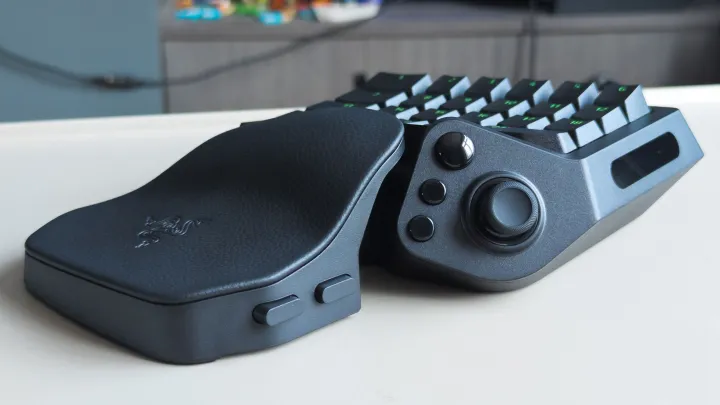
The price progression tells the line's inflation story: $79.99 back in 2013, $129.99 for the original Pro, and now $199.99 for the V2 Pro. Buy it if you play MMORPGs or MOBAs and want a joypad-and-keyboard hybrid. Skip it if you already own a previous Tartarus or can't wait for Synapse fixes. The keys are genuinely brilliant, and the rest is fixable.
A rugged phone that's more toolbox than phone
The FOSSiBOT F115 Ultra is a feature-dense utility tool wearing a smartphone's clothes. Thermal imaging. A 1,200m laser rangefinder. Sixty-four megapixels of long-range night vision that sees into the dark up to 50 metres.
Those ride on top of a regular 50MP main and 32MP selfie, all backed by a MediaTek Dimensity 7100 with 12GB of RAM, a 6.78-inch 120Hz display, and a 20,000 mAh battery.
The chip isn't the fastest around, but NikKTech says it's plenty for most uses. The battery is the real show, running up to eight days between charges in extended testing. That kills range anxiety in a way a flagship battery never quite manages.
NikKTech: FOSSiBOT F115 Ultra 5G Rugged Smartphone Review
With a thermal camera, 64MP night vision sensor, integrated laser rangefinder, and enormous battery capacity, the FossiBot F115 Ultra targets users who need more than a traditional rugged smartphone.
It earned a Golden Award, but the trade-offs are real. At roughly 700 grams and 30 millimetres thick, pocketability and one-handed use go out the window. Aimed at outdoor enthusiasts, construction workers, and field techs rather than gamers, it costs $599.99 in the US for what is ultimately an older chipset under the metal. Worth it if the thermal imager and rangefinder are the whole point.
Two power supplies, one clear winner
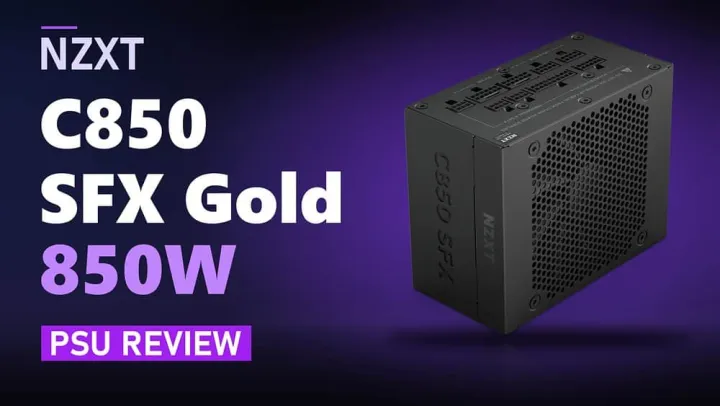
NZXT's first SFX power supply, the C850, packed 850W into a proper SFX enclosure, and Hardware Busters set it against 15 rivals. It scored 9 out of 10, with strong electrical performance and quiet operation under most loads. Only the 5VSB rail lagged behind.
The circuitry reads like a checklist of good intentions: APFC into a half-bridge LLC resonant converter, synchronous rectification on the 12V rail, DC-DC for the minor rails, and Rubycon and Nichicon caps throughout. A 92mm FDB fan with zero-RPM mode and a 10-year warranty round it out.
But here's the interesting part. NZXT's own US store was sold out, while Amazon had the black model at $133 against a $199.99 MSRP. That's a meaningful gap for a unit that scores a 9, and it matters.
Hardware Busters: NZXT C850 SFX Gold ATX v3.1 PSU Review
NZXT C850 SFX Gold review: an 850W SFX PSU tested for efficiency, noise, protection settings, and ATX v3.1 power excursions against 15 rivals.
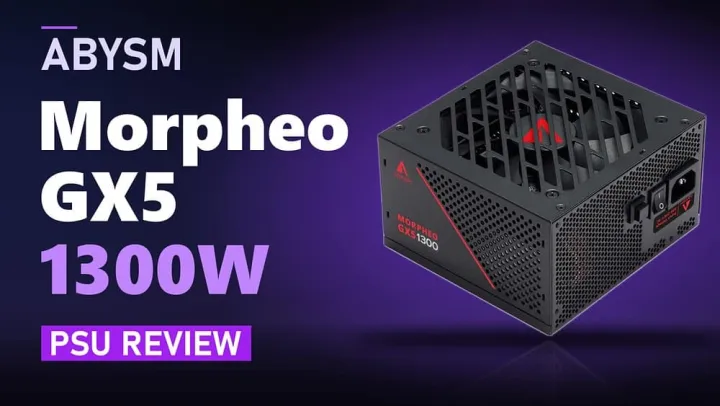
The ABYSM Morpheo GX5 1300W didn't fare as well. The Spanish brand's first PSU uses a Helly platform in a fully modular chassis with tight 12V regulation and low inrush current, plus Platinum-level efficiency in testing. The minor-rail protection settings need work, and the 120mm fan gets genuinely loud under load, dropping it to 7.8 out of 10. It sells mainly in Spain for around €180 to €200, so it's a regional value pick rather than a global one. For US builders chasing max wattage, the NZXT is the easier call, even at half the power.
Hardware Busters: ABYSM Morpheo GX5 1300W ATX v3.1 PSU Review
ABYSM Morpheo GX5 1300W review: Cybenetics Platinum efficiency, ATX v3.1 power excursions, and a Helly platform tested against 21 other PSUs.
ABYSM Morpheo GX5 1300W ATX v3.1 PSU Review - Hardware Busters