Five hardware reviews published in today's roundup, which spans a Strix Halo mini PC, a "world's fastest" gaming laptop, an AM5 Mini-ITX board, and two power supplies. Across them, bold marketing claims falter under bench scrutiny, from GIGABYTE's title narrowly edged by MSI to a Gamdias "Platinum" PSU measuring like Silver. Value emerges as the recurring battleground, with the $3,099 BOSGAME M5 winning on speed-per-dollar while the $270 ASUS B850I and Gamemax 750G get dinged for pricing. The takeaway is consistent: trust the test bench over the spec sticker before you buy.
Today's hardware reviews pit Strix Halo against Grace Blackwell, and catch a "Platinum" PSU measuring like Silver
Five reviews published in today's roundup, which spans a local-AI mini PCs, a "world's fastest" gaming laptop, AM5 Mini-ITX boards, and two power supplies. The common thread? Marketing claims that don't always survive the test bench.
There's a pattern to this week's crop of reviews, and it's a familiar one. Companies make bold claims. The bench quietly disagrees. You're looking at five very different products here, but the through-line is identical. Check the numbers yourself before you trust a spec sticker.
Computers
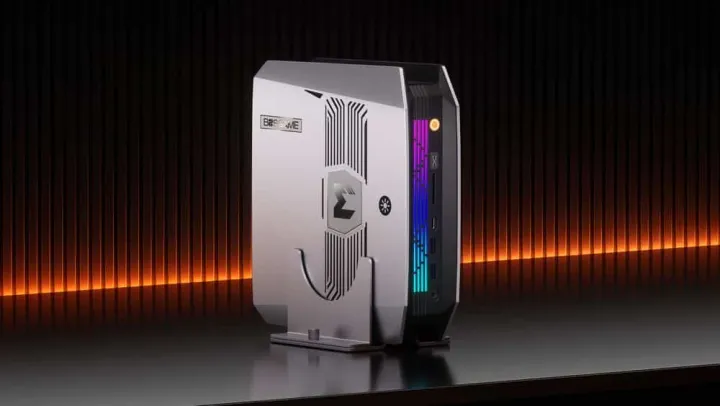
Hardware Busters bought a BOSGAME M5 specifically to watch AMD's Strix Halo platform handle the same local-AI workload the reviewer already runs on an ASUS Ascent GX10. Both machines hold 128 GB of memory. Both feed the same Qwen3.8 model into OpenCode. This is a real-world comparison, not a spec-sheet arms race.
The M5 in question ships with 128 GB and a 2TB SSD, built around a Ryzen AI Max+ 395 and Radeon 8060S graphics. The GX10 runs the GB10 Grace Blackwell chip with the same 128 GB plus a 4TB Samsung NVMe over PCIe 5.0. Keep in mind the cheaper 1TB and 2TB GX10s use PCIe 4.0 drives, so don't price-compare them against the 4TB unit.
The headline gap isn't raw speed. It's latency. On an uncached ~6,300-token prompt, the GX10 starts streaming its first token in about 8.7 seconds. The M5 takes more than 26 seconds. That's a threefold gap.
Prompt caching helps both once a prompt repeats, and once decoding begins the per-token rate narrows to roughly 14 percent. But time-to-first-token is what actually breaks a coding assistant.
On a weighted AI score the GX10 lands about 39 percent faster overall. On speed-per-dollar it scores just 53.8 percent of the M5. That isn't a power problem. It's a $7,999 price versus $3,099.
For context, NVIDIA's own Founders Edition DGX Spark with the same GB10 class, 128 GB, and 4 TB listed at $4,899.99. If that speed had matched the GX10, its value index would jump to 87.8 percent. AMD's own Ryzen AI Halo developer platform, same Max+ 395 and 128 GB, sat at $3,999.99 in-store but wasn't benchmarked.
The M5 is the value play. Great per dollar, a welcome second M.2 slot, keeps up on decode speed. It just can't match Grace Blackwell's cold-uncached latency. Worth noting both run different stacks, llama.cpp versus Ollama, so these reflect as-run configurations rather than isolated silicon. Head here to read the full Hardware Busters comparison.
Hardware Busters: BOSGAME M5 AI PC Review: Strix Halo vs ASUS GX10
BOSGAME M5 vs ASUS GX10 review: Qwen3.8 AI, CPU, GPU, RAM and 4TB SSD benchmarks, software power, temperatures, US prices and value scores.
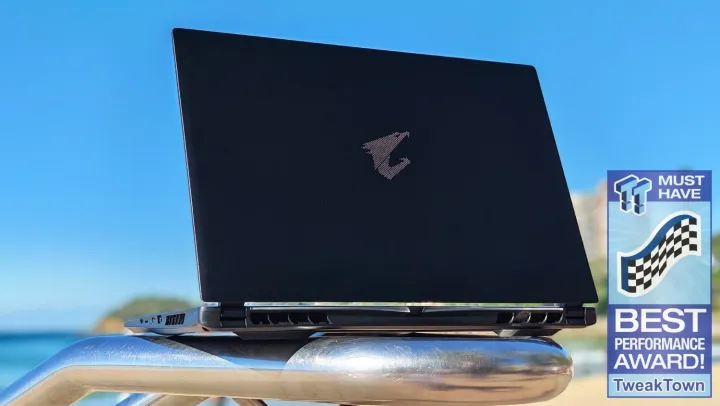
TweakTown scores the GIGABYTE AORUS Master 16 Gen 2 AM6J at 90 percent, with a Performance badge. GIGABYTE calls it the fastest gaming laptop in the world. Gen 2 also marks the company's full flip to AMD, pairing the top-tier Fire Range Ryzen 9 9955HX3D, Zen 5 on TSMC's 4nm process, second-gen V-Cache, 16 cores, 2.5 to 5.4 GHz, and no NPU, with an RTX 5090 (24 GB of GDDR7), 32 GB of DDR5-5600, and a 1TB or 2TB drive. The review unit is the top SKU.
Initial retail was $5,400. It's down to about $4,899 now. The verdict is blunt. GIGABYTE lists the cons as "very expensive; fingerprint magnet; runs hot and loud." Those aren't minor nitpicks.
The numbers are solid on paper though. GeekBench 6 GPU hit 232,601, the second-highest score here, beaten only by an MSI Titan. 3DMark Speed Way at 1440p pulled 6,135 at roughly 61 fps. Cyberpunk 2077 on 4K RT Overdrive averaged 44.6 fps. It's genuinely top-tier laptop gaming.
The display is a strong point: a 16-inch OLED at 2560 by 1600, 240 Hz, 0.2 ms, 1,000-nit HDR, 99 percent DCI-P3. Speakers rate as one of the loudest on the market. Keyboard and trackpad are excellent too.
Cooling is where it breaks down though. The reviewer says it's "hard-pressed to catch it not warm and/or noisy," with a near-hairdryer roar at max load. It shed 4 percent performance over a 30-minute Cinebench run, more than most rivals. A 230 W TDP jammed into a thin chassis is the root cause.
There's also a wrinkle on the headline claim. In GPU tests the "world's fastest" title is narrowly edged out by the MSI Titan 18 HX AI. So that headline needs an asterisk.
Genuinely excellent performance and a great screen. At nearly $4,900 you're buying into real heat, real noise, and a flimsy lightweight lid. Not cheap. Maybe not the value it claims.
TweakTown: GIGABYTE AORUS Master 16 Gen 2 AM6J (Fire Range) 16" Gaming Laptop Review
GIGABYTE's AORUS Master 16 Gen 2 pairs a Ryzen 9 9955HX3D with RTX 5090 power, but does it deliver on its fastest-in-the-world claim?
GIGABYTE AORUS Master 16 Gen 2 AM6J (Fire Range) 16" Gaming Laptop Review
Motherboards
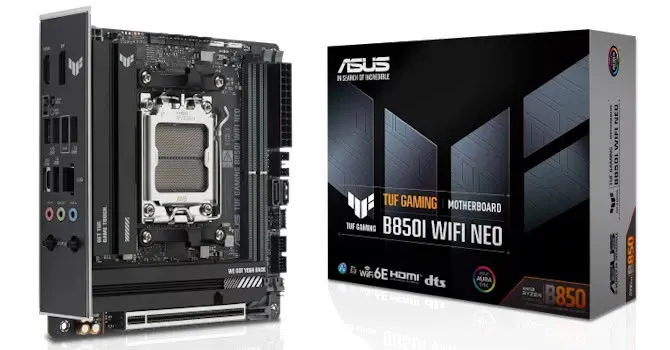
TechPowerUp takes on the ASUS TUF Gaming B850I Wi-Fi Neo at $270. ASUS now has four AM5 800-series Mini-ITX boards, and the ROG Strix B850-I's price has crept up enough to leave a pricing hole. This one slots in below it to fight ASRock, Gigabyte, and MSI under $300 options.
You get the B850 chipset, DDR5 up to 128 GB (DDR5-9600 when overclocked), one PCIe Gen 5 x16 slot, Gen 5 plus Gen 4 M.2 slots, Wi-Fi 6E, and Q-antenna plus BIOS Q-Dashboard for troubleshooting. It handles a Ryzen 9 9950X under stress without throttling. The big heatsink "just about tamed" a toasty PCIe Gen 5 SSD. EFI and software rate as best-in-class, and it's got four fan headers, dual display outputs, and USB BIOS-flashback.
So what kills the value? Price, and the competition is stiff.
At $270 it loses out. The MSI MPG B850I Edge Ti Wi-Fi at roughly the same price adds Wi-Fi 7, better audio, faster ethernet, an extra USB header, cooler VRMs, and an actively cooled M.2. ASRock's Phantom Gaming B850I Lightning sells as low as $210. Gigabyte's B850I Aorus Pro is cheaper with Wi-Fi 7 and lower M.2 temps.
TechPowerUp's bottom line is direct: "If you got change from $220 it would be worth considering, but as it stands, there are much better value options out there." Excellent board on merit. The price is what makes it hard to recommend.
TechPowerUp: ASUS TUF Gaming B850I Wi-Fi Neo Review
The ASUS TUF Gaming B850I Wi-Fi Neo is a new Mini-ITX option for Socket AM5 CPU owners and a solid effort with good performance plus a great EFI and software package. It can handle PCIe Gen 5 SSDs and AMD's flagship 16-core CPUs, but does its price give the competition the last laugh?
Power
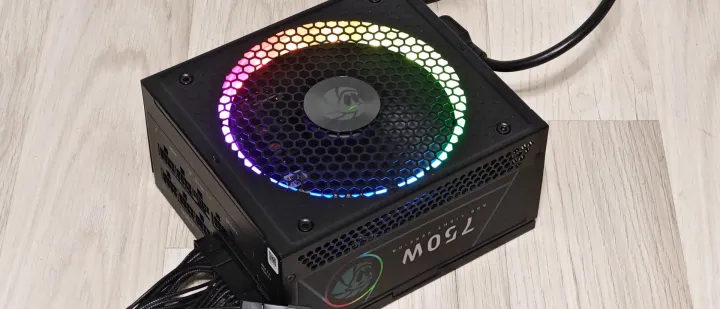
Tom's Hardware benches the Gamemax RGB PRO 750G at $105. Gamemax, behind OEM brand Sohoo, markets "affordable luxury" with loud designs at undercut prices. This is a fully modular ATX 3.1 / PCIe 5.1 unit with a 140 mm ARGB fan and a native 12V-2x6 connector. It's rated 750 W at 40 C ambient, derated 20 percent above that, which means roughly 600 W in a hot case.
The verdict: "Efficient, but pricey for an average unit with pretty lights."
The electrical core is respectable. 90.8 percent average efficiency at 230 VAC, good ripple, a Nichicon primary capacitor. But the badge can't be verified. There's no CLEAResult, Cybenetics, or PPLP database entry. The 80 Plus Gold rating is just the manufacturer asserting it. You can't check it.
It's also loud under load, has no fanless mode, and costs more than an MSI MAG A750GL or Corsair RM750e. The ARGB is honestly the best-executed part for the price, a glowing hexagonal halo under the fan grille. Mount it fan-down in a shrouded case though and the light's buried. You'd need fan-up to see it, which compromises intake. Buy for the lights, not the credentials.
Tom's Hardware: Gamemax RGB PRO 750G power supply review: Efficient, but pricey for an average unit with pretty lights
The Sohoo platform underneath measures well enough, but the fan, the capacitors, and the warranty all sit below what the price should buy.
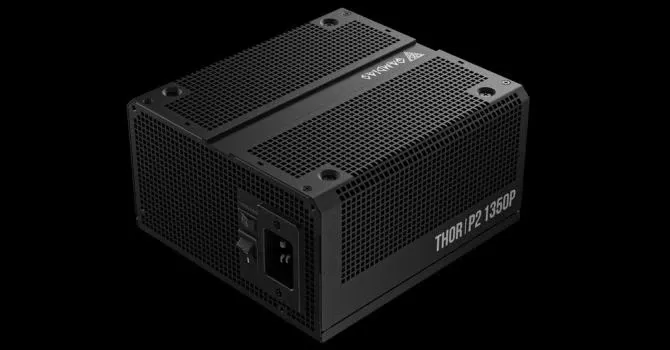
On the other end of the value scale, TechPowerUp benches the Gamdias Thor P2 1350P at about $199.90. Gamdias is normally a budget-peripheral brand, but the THOR P2 series pushes into enthusiast territory: 80 Plus Platinum, ATX 3.1, PCIe 5.1 ready.
Here's where the paper spec sheet lies. It's rated 80 Plus Platinum, meaning 92/94/90 percent at 20/50/100 percent load. The bench measured 89.61/90.65/87.83 percent. On a 230 V bench that aligns with an 80 Plus Silver unit. The power factor also missed the claimed 0.99.
The internals aren't garbage though. Rubycon bulk caps, 1120 µF, low-RDS-on MOSFETs, a 12-year warranty, flat flexible cables, and a compact 160 mm chassis. It caps the fan at 1685 RPM despite a 2300 ceiling, keeping it quiet up to about 70 percent load. Voltage regulation stays within ATX 3.0 limits across all rails.
But there are construction shortcuts. Uneven current sharing across the PCIe cable wires showed up in thermal imaging. Side grilles can dump heated air back into your case. The daughter boards use right-angle slots with no mechanical support. Ripple is spec-compliant but peaks near 48 mV on +12V at high load. So it looks like a steal on paper: Platinum, 1350 W, under $200, 12-year warranty, but real-world efficiency sits near Silver. You get steady, compliant power and a lot of wattage per dollar, if peak efficiency isn't your main worry.
TechPowerUp: Gamdias Thor P2 1350P Review
Gamdias enters the high-wattage market with the THOR P2-1350P, offering 1350 W of ATX 3.1 power, Rubycon capacitors, and a 12-year warranty for under $200. However, electrical performance doesn't live up to marketing promises, and factors contributing to the low MSRP start to show through.